Cosmetic Jar Compatibility: Match Jar, Lid, and Insert
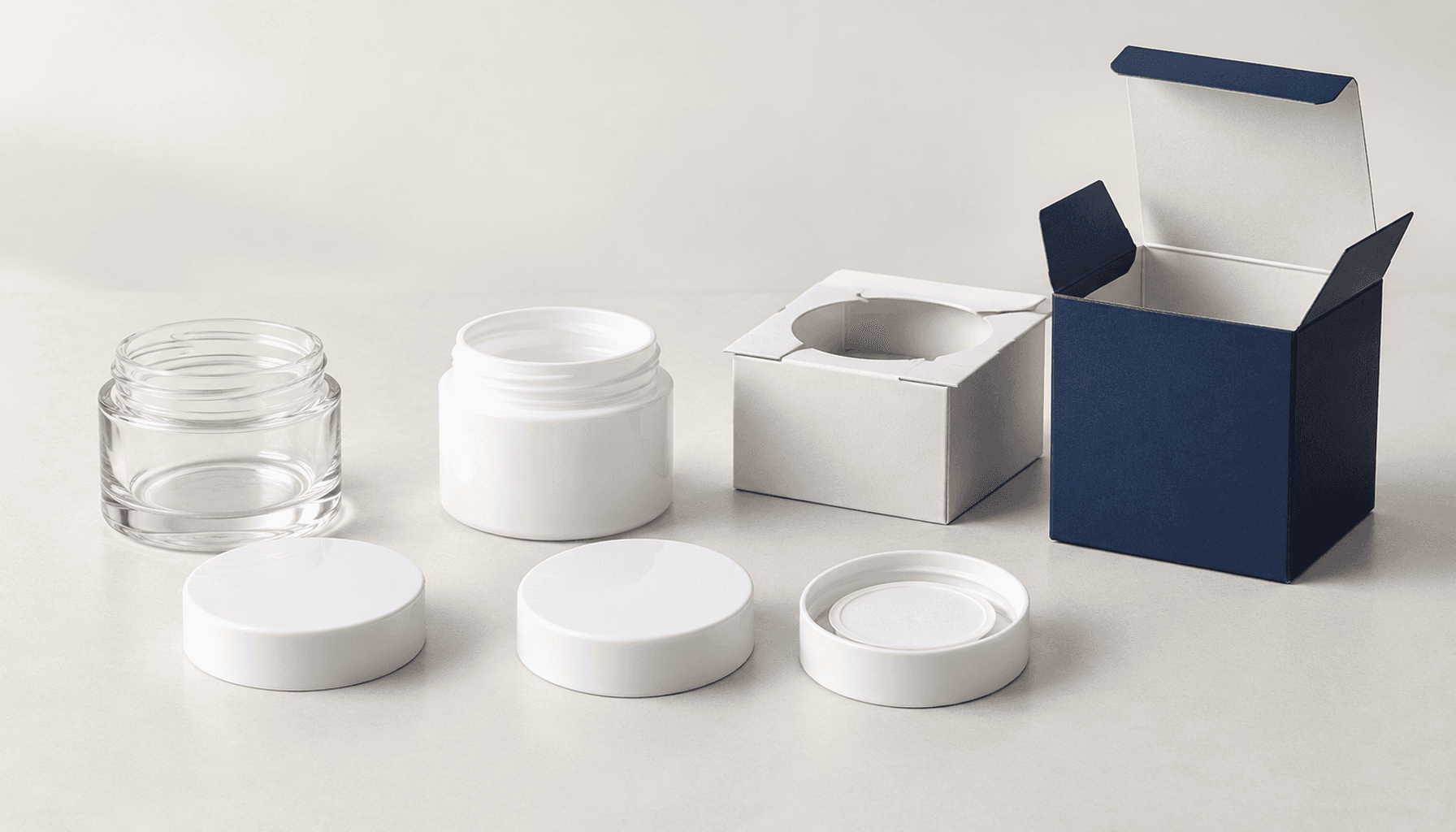
Table of Contents
- Start Cosmetic Jar Compatibility With the Filled Assembly
- Define the Formula, Fill Capacity, and Use Conditions
- Glass and Plastic Jar Assemblies: Comparison Table
- Specify the Jar, Lid, and Liner Together
- Fit the Insert Around the Approved Jar Assembly
- Validate Samples in an Ordered Approval Sequence
- Coordinate CosunPack Jar, Insert, and Carton Options
- Budget for Compatibility Trials, Revisions, and Tooling
- Frequently Asked Questions About Cosmetic Jar Compatibility
- Plan Your Packaging Set With CosunPack
Confirm cosmetic jar compatibility on the filled jar, lid, and liner before finalizing the protective insert and carton. Drawings establish fit requirements; production-representative samples filled with your actual formula show whether the proposed assembly meets the agreed acceptance criteria.
Table of Contents
Start Cosmetic Jar Compatibility With the Filled Assembly
Cosmetic jar compatibility is the ability of the jar, closure, liner, formula, protective insert, and carton to function together under specified filling, storage, distribution, and use conditions. The primary pack is the formula-contact assembly; the protective insert positions that closed assembly inside its carton.
A thicker liner can alter lid seating and assembled height. A wider replacement lid can change insert clearance and carton removal. Link every component drawing and approved sample to one assembly revision.
Define the Formula, Fill Capacity, and Use Conditions
Build one specification brief covering the formula, primary pack, and protective packaging. For a US launch, identify the filling site and distribution route so samples represent the intended process and handling.
Brief essentials: formula revision; target fill in grams (g) or milliliters (mL); finished dimensions in millimeters (mm); filling and storage temperatures with units; quantity per stock keeping unit (SKU).
Distinguish Nominal Capacity, Brimful Capacity, and Working Fill
Nominal capacity is the supplier’s stated size designation, which needs a measurement basis. Brimful capacity is the volume to the defined overflow level. Working fill is the intended product amount, allowing specified headspace and closure intrusion.
For example, a 50 mL catalog jar still needs evaluation for its intended working fill. When filling by mass, establish occupied volume using the formula’s measured density at the relevant temperature; 50 g and 50 mL are different specifications. Confirm space for any lid or liner projection.
Record Formula Contact, Filling Temperature, and Storage Conditions
Record relevant formula characteristics, including oils, solvents, fragrance, acidity, and viscosity. Identify every contact surface: jar interior, liner facing, seal membrane, and any exposed closure material. Share filling temperature, cooling sequence, capping delay, storage conditions, and expected bathroom or travel use.
The responsible formulator or laboratory should select observations, potentially including odor, appearance, viscosity, package mass change, and material damage. Document each test’s duration, temperature, orientation, sample count, and acceptance criteria. Shelf-life and microbiological safety conclusions require their own appropriate validation.
Glass and Plastic Jar Assemblies: Comparison Table
Glass and plastic jars can share an approval sequence, while test methods and acceptance limits must reflect their actual materials. Compare glass vs plastic cosmetic jars at the assembly level.
| Decision | Glass jar assembly | Plastic jar assembly |
|---|---|---|
| Formula contact | Evaluate the glass surface plus closure and liner contacts. | Evaluate the exact resin, additives, colorant, closure, and liner. |
| Filling conditions | Assess thermal shock risk and the proposed filling/cooling sequence. | Assess heat distortion and dimensional change at the proposed filling temperature. |
| Storage exposure | Inspect seal behavior, formula changes, and relevant surface interactions. | Inspect swelling, stress cracking, permeation-related changes, and seal behavior. |
| Handling loads | Check breakage risk and support for the filled mass. | Check deformation and scuffing under insert and shipping loads. |
| Dimensional variation | Measure neck, body, and base variation on representative components. | Measure molding variation, ovality, and closure seating on representative components. |
| Insert design | Evaluate body/base support and cushioning in the packed set. | Evaluate retention without excessive wall deflection or rubbing. |
Specify the Jar, Lid, and Liner Together
Confirm cosmetic jar closure compatibility by comparing controlled jar, lid, and liner drawings, then testing assembled samples. A common diameter designation is only a starting point; sealing geometry and usable thread engagement must also match.
Confirm Neck Finish, Sealing Surface, and Closure Engagement
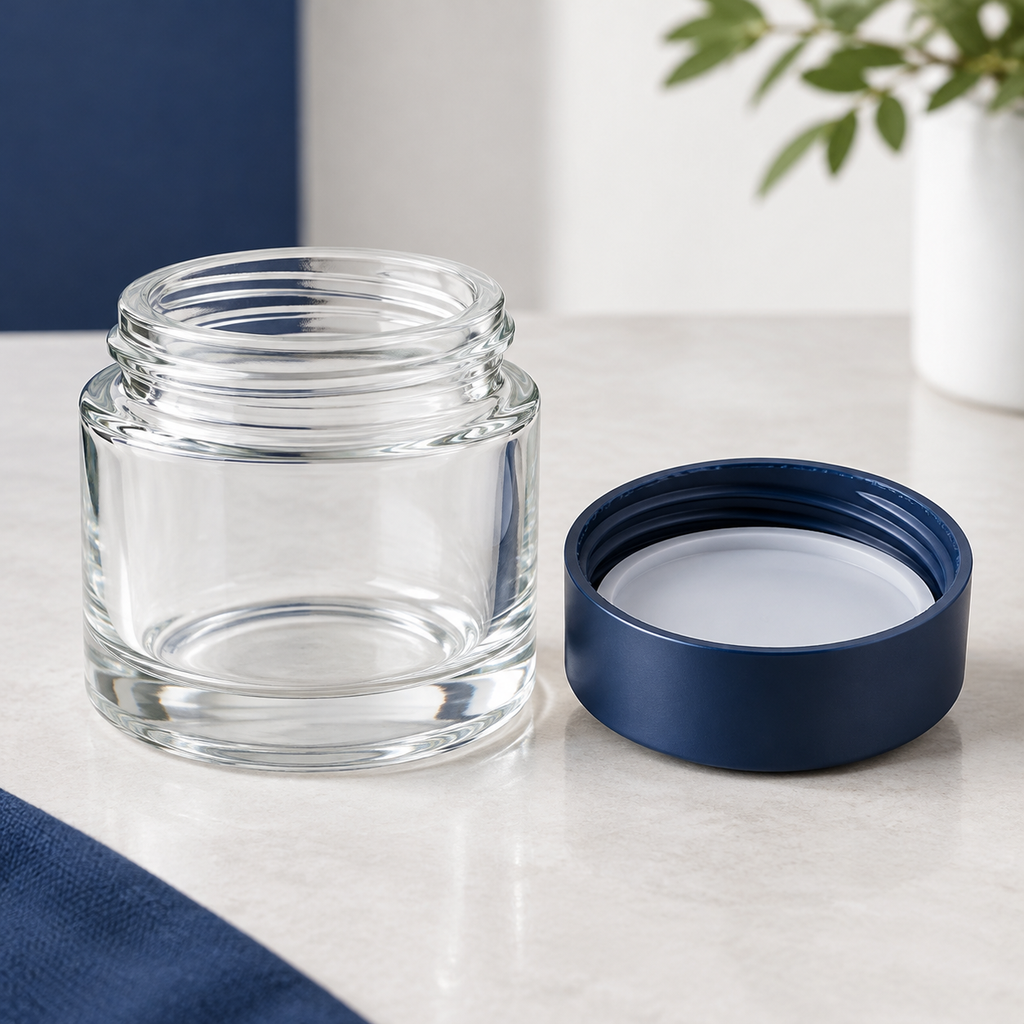
Specify the neck finish—the geometry around the opening that mates with the closure—including thread profile, pitch, starts, neck height, and sealing-land dimensions. Confirm lid internal geometry, sealing contact, and intended seating position.
On samples, check smooth starting, consistent engagement, square seating, and full sealing contact without thread interference or premature bottoming. Measure critical dimensions on multiple pieces spanning expected manufacturing variation. Record assembled height with the intended liner installed. Drawings establish geometry; filled-pack testing establishes performance under agreed conditions.
Agree on Liner Contact and Closure Application Checks
Cosmetic jar liner selection requires contact-material review and a sealing trial. Specify the liner’s construction, product-contact facing, thickness tolerance, compression behavior, and retention inside the lid. If using an induction membrane, validate its bonding layer against the exact jar surface and application process.
Agree on application and removal torque—the rotational effort used to tighten or open the lid—in newton-meters (N·m). Establish limits using the selected components and filling equipment. Recheck opening torque and sealing after defined storage and opening cycles. For leakage checks, specify fill, orientation, temperature, duration, method, and pass/fail criteria. The chosen method must address the intended exposure and required detection sensitivity.
Fit the Insert Around the Approved Jar Assembly
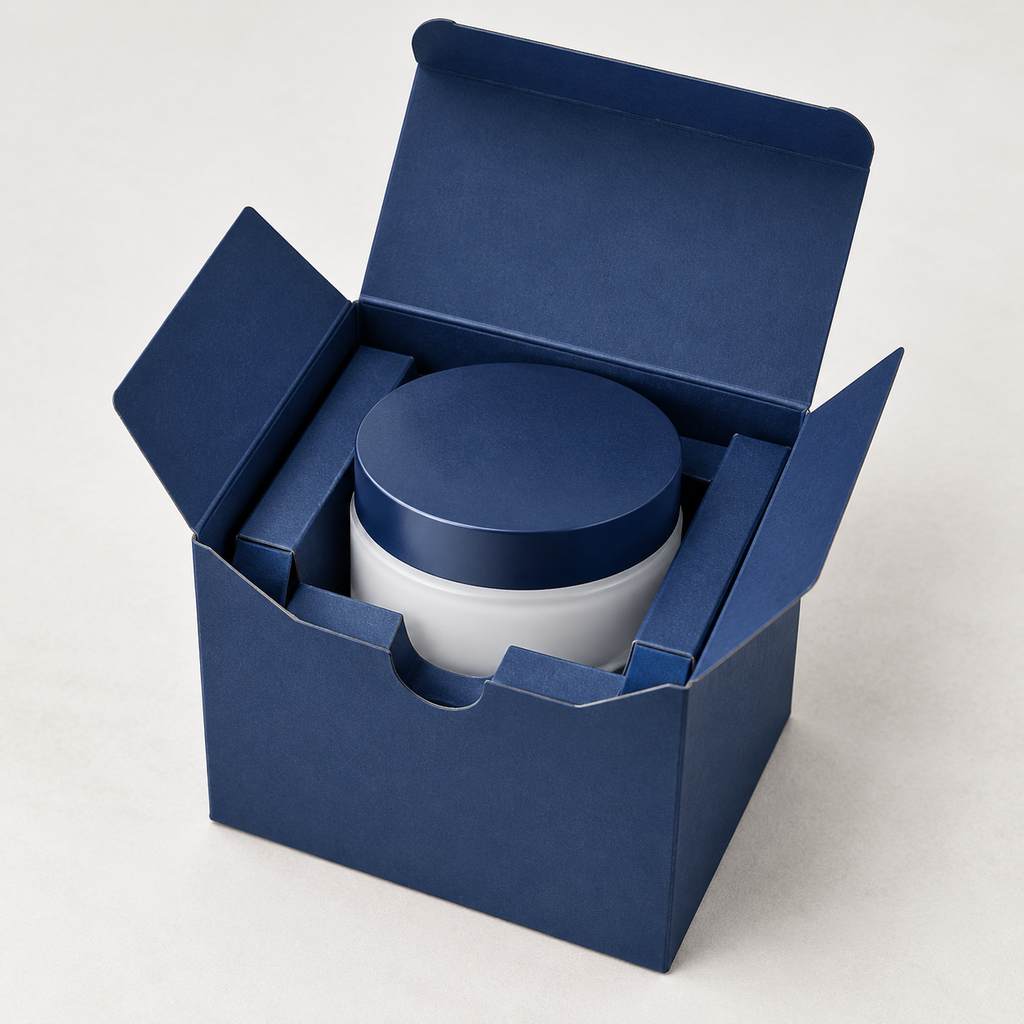
Design the protective insert around the approved closed jar. Usually, locate and support the jar body or base; lid contact needs a deliberate, validated purpose. Holding only the lid can introduce opening forces or transmit loads through the closure. Distinguish this protective insert from a formula-contact liner.
Account for Dimensional Variation and Decoration Clearance
Jar insert clearance is the controlled space between the finished assembly and insert at defined contact points. Specify whether each gap is per side or across the full diameter. Include body and lid size ranges, ovality, overall height, label thickness, coating buildup, and relevant board or pulp variation.
Check the smallest opening against the largest assembly for insertion, then the largest opening against the smallest assembly for retention. Evaluate scuffing at decorated areas. Paperboard springback, folds, and molded-pulp geometry affect real fit. Representative materials and tooling are needed to confirm repeatable assembly beyond the initial hand-cut concept.
Check Retention, Removal, and Clearance Above the Lid
Provide finger access to remove the jar by its body without forcing the lid to turn. Check loading and removal with filled samples in the intended orientation. Confirm that insertion preserves jar shape, liner position, and decoration.
Assess clearance above the lid using the maximum assembled jar height, insert support height, carton’s minimum internal height, and inward-projecting flaps. Confirm that the closed carton stays clear of the lid under expected loads. Retention and cushioning require separate evaluation: limiting movement alone does not demonstrate impact protection.
Validate Samples in an Ordered Approval Sequence
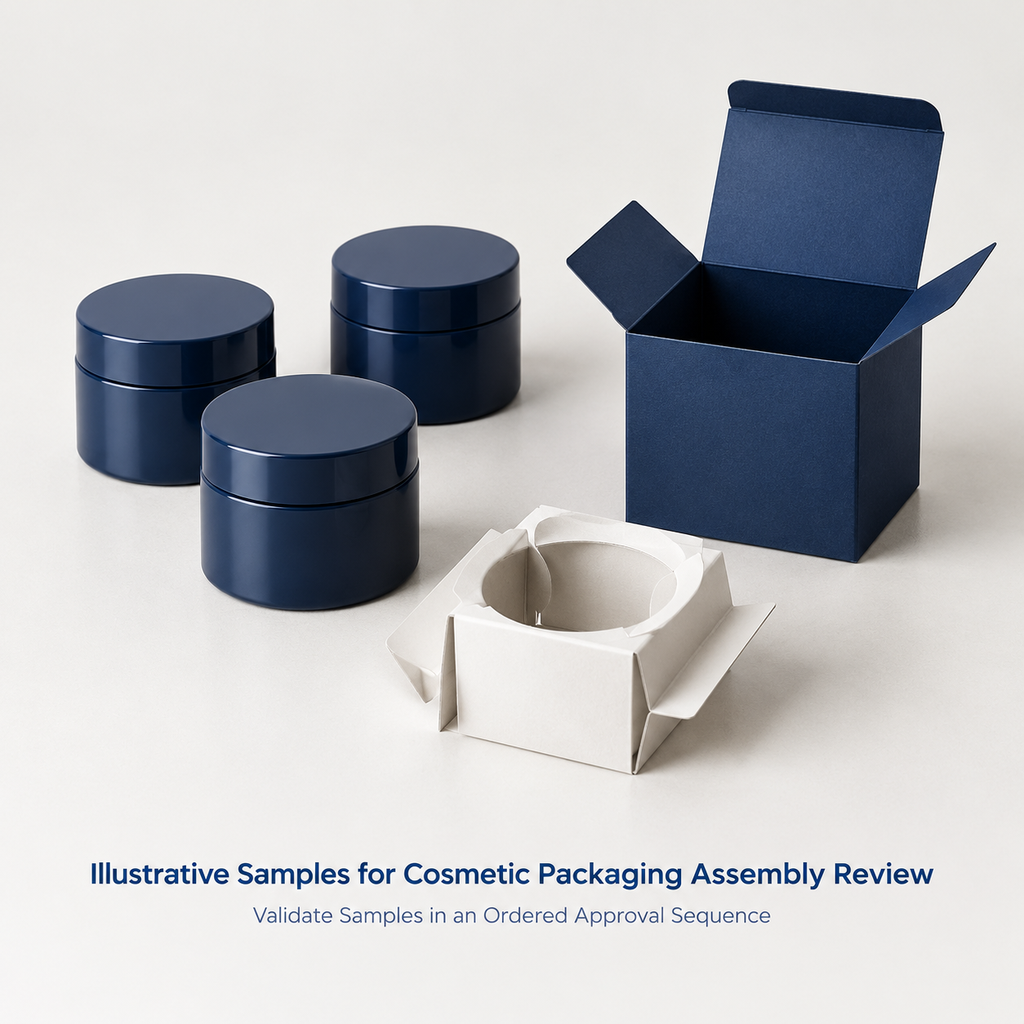
Approve production-representative jar, lid, and liner samples against agreed formula-compatibility gates before finalizing insert tooling and carton dimensions. Follow this cosmetic packaging sample approval sequence:
- Review controlled records. Confirm component drawings, material identities, tolerances, formula revision, filling conditions, test responsibilities, and acceptance criteria. Identify what each prototype can demonstrate.
- Check empty-component fit. Measure representative jars, lids, and liners. Assess thread engagement, sealing contact, assembled height, and application behavior. Record sample and tooling identities.
- Run filled-pack trials. Use the actual formula and intended filling/capping process. Evaluate agreed storage conditions, orientations, opening cycles, and leakage methods. Record conditions and results; the responsible technical team determines the evidence needed for the intended use and shelf-life target.
- Freeze the primary-pack configuration. After agreed approval gates are met, release the jar, closure, liner, and finished dimensional ranges for protective-pack development.
- Validate the complete pack-out. Fit decorated jars into representative inserts and cartons. Check assembly, removal, rubbing, retention, and lid clearance. Evaluate the filled shipping configuration under an agreed distribution test plan, then inspect both primary and protective packaging.
- Release a documented production reference. Retain approved samples, drawings, material specifications, test reports, and revision records. Define incoming, in-process, and pre-shipment checks, plus the changes that trigger reapproval.
Use CosunPack’s packaging quality checkpoints to discuss inspection scope and batch records against this approved specification.
Coordinate CosunPack Jar, Insert, and Carton Options
CosunPack’s published manufacturing model combines Guangzhou paper printing and converting with specialized equity-partnered facilities for glass and plastic containers. One Guangzhou team coordinates component fit, approvals, quality checkpoints, and shipment consolidation. These catalog structures provide starting points for a matched set; suitability depends on specifications and samples.
| Catalog structure | Assembly review |
|---|---|
| Glass cosmetic jar | Review its lid and liner together; supply the approved closed assembly for insert development. |
| Single-wall plastic jar | Confirm resin, grade, wall behavior, and lid fit before setting cavity retention. |
| Paperboard inserts | Develop the cavity, folded support, and removal openings around the approved jar and carton interior. |
| Molded-pulp inserts | Develop body/base support, surface contact, and dimensional allowances for the same closed assembly. |
For either insert, specify the matched folding carton’s internal dimensions, board thickness, flap intrusion, and assembly sequence. The retail carton and shipping pack need packed-product validation.
Budget for Compatibility Trials, Revisions, and Tooling
Budget for approval work alongside the repeat unit price. Ask the quotation to separate:
- Formula-contact and filling trials, laboratory work, samples, and sample freight.
- Structural prototypes and revisions, including decoration changes that alter fit.
- Jar or lid molds where required, paperboard cutting dies, or molded-pulp tooling, with ownership, revision charges, and approval gates stated.
- Recurring components, assembly labor, inspection, packed dimensions, and delivery costs for the named destination.
A material or lid change can reopen approval work and make an insert tool obsolete. Confirm minimum order quantity (MOQ) for each component and quantity per SKU; matched components may have different ordering constraints. Prices, sampling schedules, and production timing require project-specific quotations. Release tooling against the approved revision.
Frequently Asked Questions About Cosmetic Jar Compatibility
- How do I confirm that a cosmetic jar, lid, and liner fit together?
Compare controlled drawings for neck finish, lid geometry, sealing surface, and liner construction. Then measure representative components and evaluate engagement, seating, application torque, and filled-pack sealing under documented conditions. Record the approved combination and revision.
- Can glass and plastic cosmetic jars use the same compatibility test plan?
They can follow the same approval sequence, with methods and acceptance limits adapted to each material. Glass assemblies need relevant thermal and breakage checks; plastic assemblies need resin-specific evaluation of deformation, stress cracking, and permeation. Both need formula, closure, and liner evaluation.
- Should a cosmetic jar insert hold the jar body or the lid?
Usually, support and locate the body or base. Any lid contact should serve an intentional function and be validated for closure disturbance and load transfer. Check retention, finger access, decoration contact, and clearance in the complete carton.
- Which samples should be approved before finalizing the carton and insert?
Approve production-representative jar, lid, and liner samples with the actual formula against agreed compatibility gates. Use their approved finished dimensions to develop the insert and carton. Then approve representative decorated samples in the complete pack-out before production release.
FAQ
How do I confirm that a cosmetic jar, lid, and liner fit together?
Compare controlled drawings for neck finish, lid geometry, sealing surface, and liner construction. Then measure representative components and evaluate engagement, seating, application torque, and filled-pack sealing under documented conditions. Record the approved combination and revision.
Can glass and plastic cosmetic jars use the same compatibility test plan?
They can follow the same approval sequence, with methods and acceptance limits adapted to each material. Glass assemblies need relevant thermal and breakage checks; plastic assemblies need resin-specific evaluation of deformation, stress cracking, and permeation. Both need formula, closure, and liner evaluation.
Should a cosmetic jar insert hold the jar body or the lid?
Usually, support and locate the body or base. Any lid contact should serve an intentional function and be validated for closure disturbance and load transfer. Check retention, finger access, decoration contact, and clearance in the complete carton.
Which samples should be approved before finalizing the carton and insert?
Approve production-representative jar, lid, and liner samples with the actual formula against agreed compatibility gates. Use their approved finished dimensions to develop the insert and carton. Then approve representative decorated samples in the complete pack-out before production release.
Plan Your Packaging Set With CosunPack
Approve the primary pack first, then carry its controlled dimensions into the insert and carton.
Request a specification review covering your product, formula and filling conditions, intended use, fill capacity, dimensions, quantity per SKU, preferred materials and finishes, artwork status, US destination, and target date. CosunPack can review the jar, closure, liner, insert, carton, and label interfaces, plus sampling and production options, for a written project quotation.
Use the contact page to prepare your inquiry email, then review and send it from your own account. The form prepares a draft; it does not send inquiries or upload files. Share confidential artwork through an agreed channel after a nondisclosure agreement if needed.
About CosunPack Engineering
CosunPack is an OEM/ODM packaging manufacturer established in 2008 in Guangzhou, China. We specialize in custom paper boxes, flexible barrier pouches, rigid boxes, and bottles with low MOQ and direct worldwide export.
Need Custom Packaging for Your Brand?
Get free dieline engineering support and a factory-direct quote in 24 hours.