Return-Ready Mailer Specifications for Ecommerce Brands
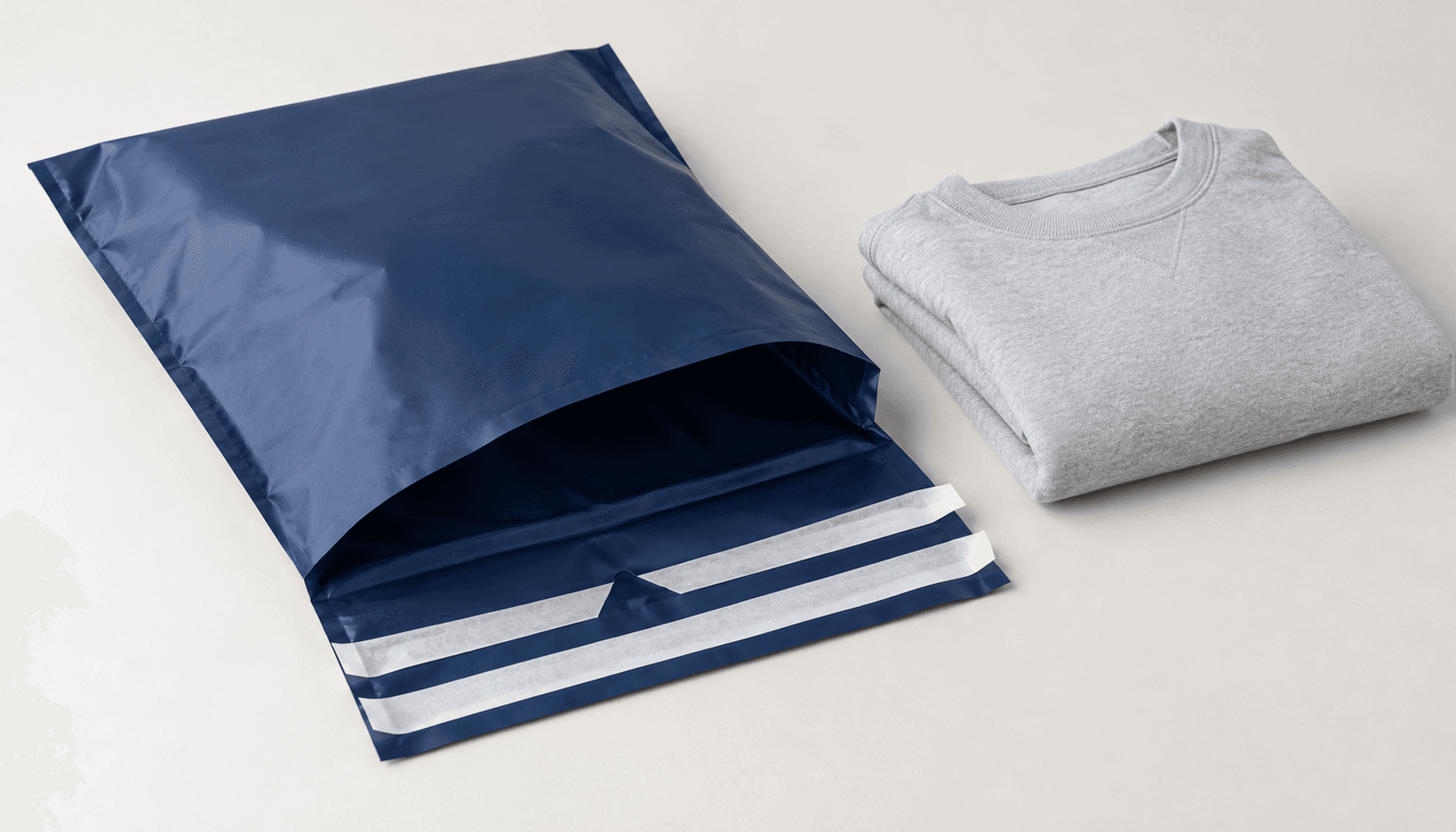
Table of Contents
- Define What the Mailer Must Do on the Return Trip
- Write Return-Ready Mailer Specifications Around Both Packing Cycles
- Measure Usable Space Before and After Opening
- Allow for Product Thickness, Gussets, and Closure Overlap
- Compare Single-Strip and Dual-Strip Mailer Configurations
- Design the Opening and Resealing Sequence
- Keep the Return Adhesive Protected During the Outbound Trip
- Position the Opening Feature Away From the Return Closure
- Plan Instructions and Replacement Shipping-Label Placement
- Select Film, Padding, and Seams for the Intended Contents
- Run an Outbound-and-Return Sample Trial Step by Step
- Review CosunPack Return-Ready and Expandable Mailer Options
- Compare Material, Fulfillment, and Repacking Costs
- Frequently Asked Questions About Return-Ready Mailers
- Plan Your Packaging Set With CosunPack
Return-ready mailer specifications should define two complete packing cycles: outbound fulfillment and customer return. A suitable design preserves a protected second adhesive strip, enough usable space after opening, and a clear location for the replacement shipping label.
Table of Contents
Define What the Mailer Must Do on the Return Trip
A return-ready mailer is a shipping envelope designed to retain a usable closure and sufficient protection for a planned return after its first opening. A dual adhesive strip mailer normally provides one fresh adhesive zone for each trip; it does not imply repeated reopening of either seal.
Define whether customers return the full order, one item, or an item with its original protective wrap. Include the expected time between delivery and return, packing conditions, and product weight.
A used mailer cannot always be reused. Punctured film, split seams, contamination, damaged padding, or a torn return flap can make replacement packaging necessary. Your return instructions should explain when customers need an alternative pack.
Write Return-Ready Mailer Specifications Around Both Packing Cycles
Specify the unused mailer and its required condition after opening on the same controlled drawing. Identify the outbound seal, opening path, retained flap, return adhesive, and both label positions.
Identify each size by stock-keeping unit (SKU). Use one master unit system on drawings, with agreed conversions where US fulfillment teams work in inches and pounds.
Measure Usable Space Before and After Opening
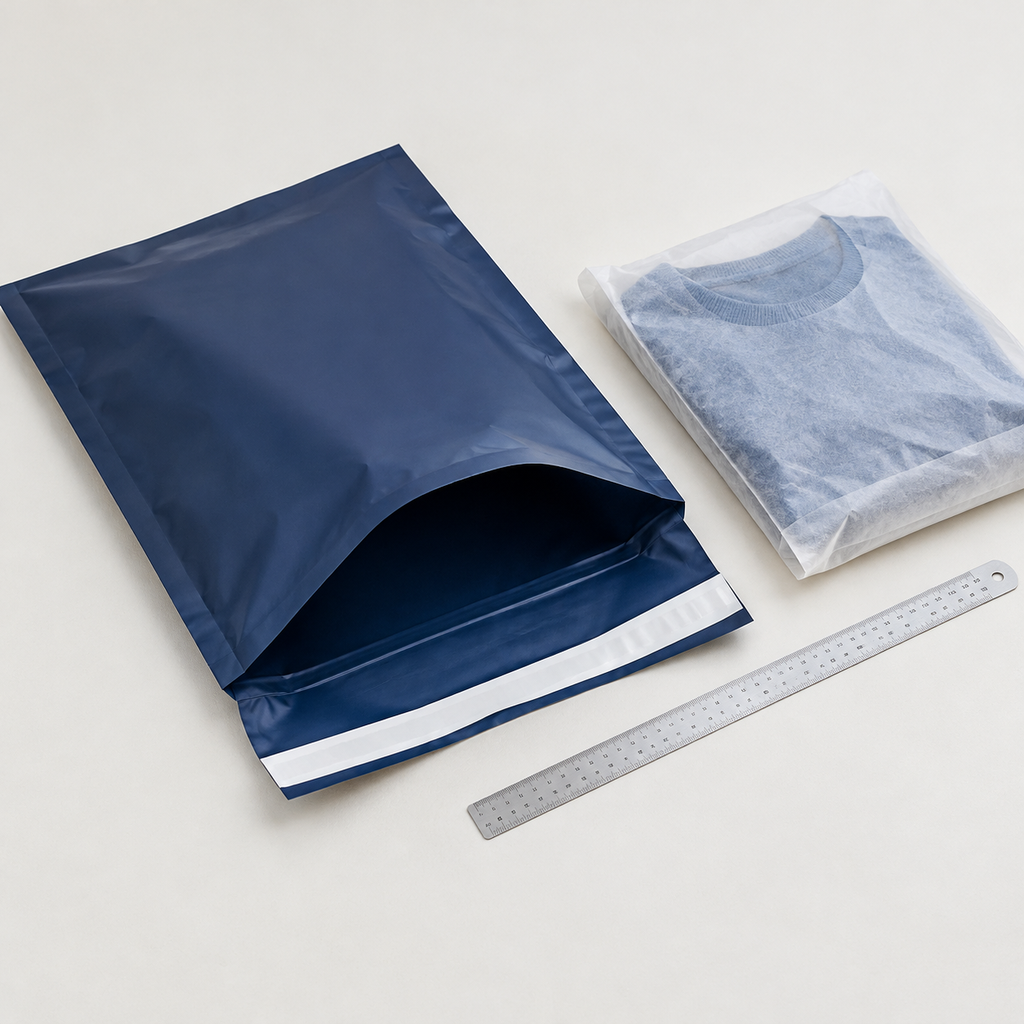
Remaining usable space depends on the opening path and return fold position; there is no universal allowance. Measure the cavity between the inside seam boundaries and the intended closure line, excluding the flap and sealed margins.
Record usable mailer dimensions before shipping and after normal opening. Then verify fit with the actual return contents because flat measurements alone do not establish three-dimensional capacity.
For an illustrative requirement, a folded garment measuring 300 × 220 × 60 millimeters (mm) must fit with its retained wrap during repacking. These are assumed product dimensions, not a recommended mailer size. Establish the required envelope size with physical samples.
Allow for Product Thickness, Gussets, and Closure Overlap
Allow enough space for customers to repack without reproducing warehouse compression or folding. Soft goods may occupy more volume after unpacking, while a partial return may leave loose material around the contents.
A gusset is a folded panel that opens to provide depth. State whether its quoted dimension describes the folded tuck or fully opened depth, and confirm how expansion changes the available width and flap reach.
Check that the return adhesive lands completely on the intended surface without stretched film or puckered corners. Define the required overlap and positional tolerances from the approved sample.
Compare Single-Strip and Dual-Strip Mailer Configurations
Choose the configuration around the return workflow and packed volume. A second strip provides a reserved closure; gussets provide expansion. Each function needs separate approval.
| Configuration | Return arrangement | Main validation |
|---|---|---|
| Single-strip with one shipping seal | Separate suitable tape or replacement packaging is generally needed. | Define the additional materials and customer instructions. |
| Flat dual-strip | A protected second strip closes the retained flap. | Check opening damage, remaining cavity, and adhesive contact. |
| Expandable dual-strip, when confirmed | Gussets accommodate bulk; a separate strip provides return closure. | Check expanded fit, gusset intersections, and flap reach after opening. |
Design the Opening and Resealing Sequence
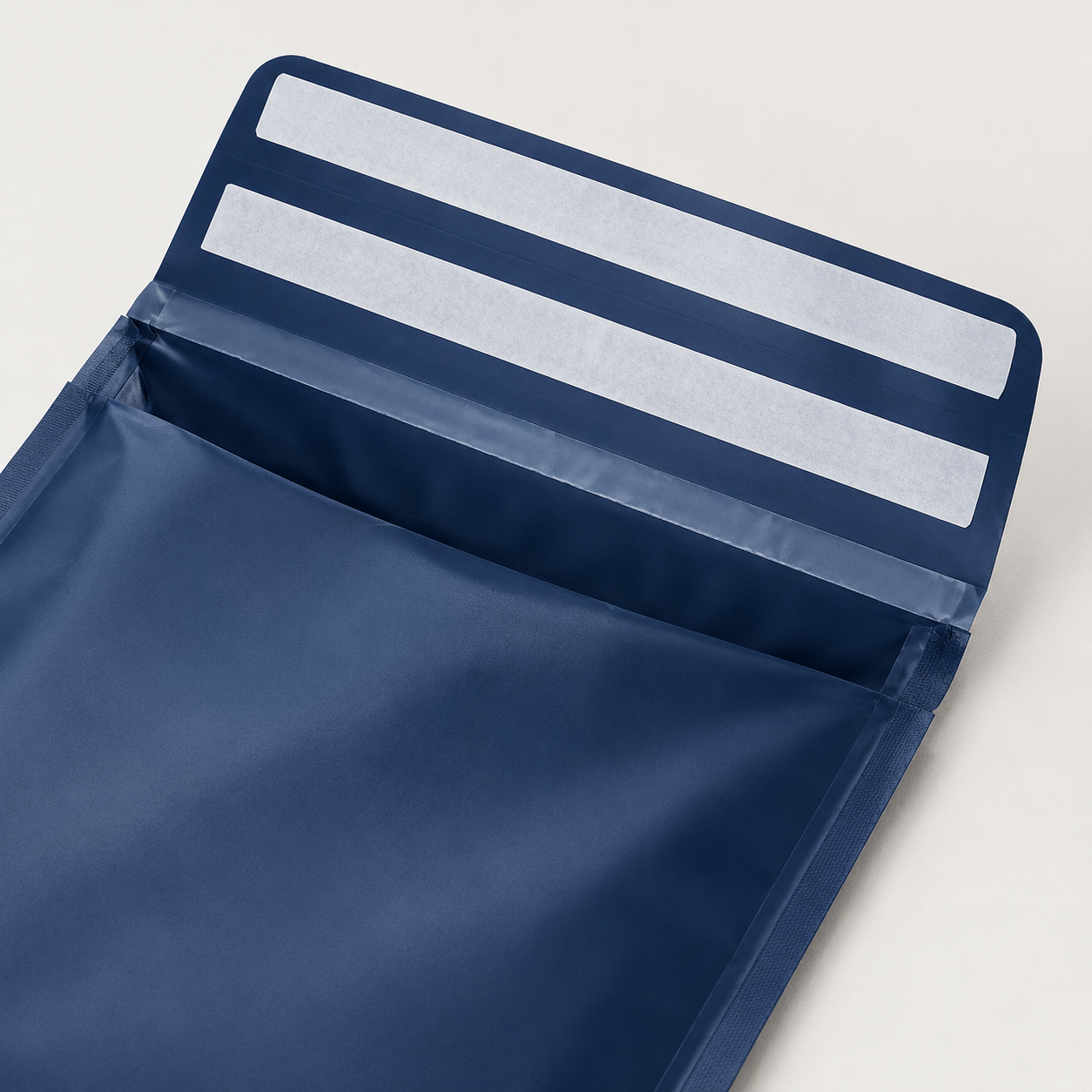
A workable resealable return mailer design makes each action identifiable: seal for dispatch, open along the intended feature, repack, expose the reserved adhesive, reseal, and replace the shipping label.
Review drawings showing the unused, outbound-sealed, opened, and return-sealed states. The approved geometry should explain what is removed and what remains usable.
Keep the Return Adhesive Protected During the Outbound Trip
The return adhesive should retain its release liner throughout outbound packing, handling, and customer opening. Specify independently removable liners so packers can expose only the outbound adhesive.
Check liner accessibility, accidental lifting, and adhesive contamination from lint or handling. Evaluate the reserved strip after the expected storage and return interval under agreed conditions. A fresh, immediately resealed sample does not represent adhesive that has remained inside a delivered package for weeks.
Position the Opening Feature Away From the Return Closure
Position the return mailer opening strip so its tear path preserves the reserved adhesive, retained flap, and necessary seams. A tear tape, perforation, or other opening feature must be evaluated in the proposed construction.
Specify clearances and manufacturing tolerances on the drawing. Observe whether users can find the opening feature and whether tears run into the return area at corners or seam intersections. Unplanned cutting or pulling can remove the very material needed for resealing.
Plan Instructions and Replacement Shipping-Label Placement
Print short instructions beside the relevant features: which liner to remove first, where to open, and which strip to reserve. Test the wording with people unfamiliar with the design.
Reserve a supported, reasonably flat return-label area away from seams, gussets, and the opening feature. Follow the selected US carrier’s current instructions for removing or fully covering obsolete shipping addresses, routing marks, and barcodes.
Test the actual label on handled film, including any proposed placement over an old label. Check adhesion and scan readability after repacking; a loose fold beneath the label can change both.
Select Film, Padding, and Seams for the Intended Contents
Select the complete construction around product weight, edges, abrasion, and protection needs across both trips. Polyethylene (PE) film is one option for soft goods, but resin description or thickness alone does not establish shipping performance.
Specify thickness in micrometers (µm) or mils, where one mil equals 0.001 inch. State the tolerance and whether the measurement describes a single wall. Define seam positions and construction, especially where expanded gussets concentrate load.
Padding reduces the usable cavity and can change condition during outbound handling. Confirm whether customers must retain an inner bag, wrap, or protective component. Products needing substantial impact or edge protection may require a different shipping structure. Return capability depends on the complete pack and its condition after delivery.
Run an Outbound-and-Return Sample Trial Step by Step
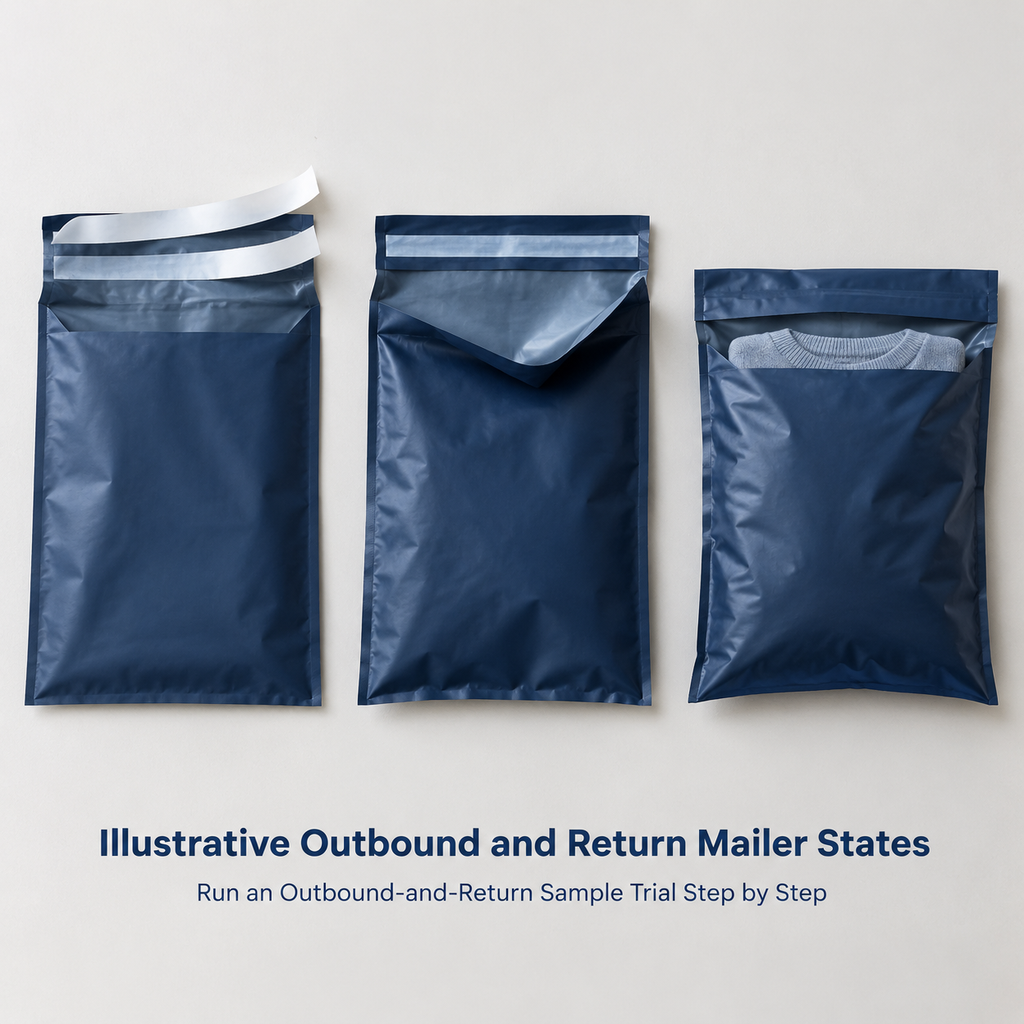
Return mailer sample testing should carry the same specimens through both journeys. Assess opening damage immediately after opening, then evaluate resealing after realistic repacking and the agreed adhesive bonding interval.
- Agree the protocol. Define sample quantity, product variants, acceptance criteria, storage interval, and handling sequence. Record temperature, relative humidity, duration, loads, and any drop conditions used.
- Inspect unused samples. Record drawing revision, sample identification, internal dimensions, liner condition, seams, and opening-feature positions.
- Pack outbound. Use representative products and protective components. Expose only the outbound adhesive. Record packing time, closure alignment, and the shipping-label position.
- Apply outbound conditions. Use the agreed conditioning and handling sequence. Keep existing damage on each specimen for the next stage.
- Observe customer opening. Ask unfamiliar users to follow the printed instructions without coaching. Photograph tear paths, measure remaining usable space, and inspect the protected return strip.
- Repack and reseal. Include realistic loose folding and intended partial returns. Record liner removal, flap reach, wrinkles, and closure contact. Use the specified application pressure and bonding interval.
- Replace the label. Follow the intended label workflow. Check obsolete markings, label adhesion, and readability on the packed surface.
- Apply return conditions. Inspect closure lifting, seam separation, punctures, and product condition after the second handling sequence. Record failures by sample and cause.
A usability trial establishes how people operate the design; handling evaluation addresses the agreed distribution conditions. Both inform approval. Use CosunPack’s packaging quality checkpoints to discuss the inspection scope, records, and acceptance criteria for your project.
Review CosunPack Return-Ready and Expandable Mailer Options
CosunPack’s published formats provide starting points for ecommerce return packaging. Compare the return-ready poly mailer with the expansion poly mailer when return contents need additional depth.
| Published product | Relevant feature | Confirm for your project |
|---|---|---|
| CS-0134 Return Ready Poly Mailer | Dual adhesive strips for a planned return. | Opening method, retained flap, adhesive protection, and usable return dimensions. |
| CS-0126 Expansion Poly Mailer | Side gussets for bulky soft goods. | Feasibility of the requested dual-strip configuration, expanded fit, and return closure geometry. |
The expansion format alone does not establish a reserved return seal. Review alternatives within the mailer category if the required protection or repacking volume changes. Approve the ordered construction through drawings and physical samples.
Compare Material, Fulfillment, and Repacking Costs
Compare the cost of the complete workflow using your order mix, return frequency, and observed packing performance. Bag price alone excludes several decisions that affect the project.
- Material, printing, tooling, sampling, and quantity per SKU.
- Outbound packing time, liner handling, extra tape, and protective components.
- Carton quantities, storage space, and packed shipping dimensions.
- Return instructions, replacement labels, failed resealing, and replacement packaging.
Use trial observations to estimate labor and failure costs. Obtain quotations against the same approved specification and quantities; a dual-strip design does not establish a fixed saving.
Frequently Asked Questions About Return-Ready Mailers
What makes a dual-strip mailer suitable for a planned return shipment?
It needs independently protected adhesive zones, an opening path that preserves the return flap, sufficient space for repacking, and adequate protection after delivery. Verify these features together on representative samples through both packing and handling cycles.
How much usable space remains after a return-ready mailer is opened?
The remaining space depends on the tear path, retained seams, and return closure position. Measure the opened cavity against the approved drawing, then confirm fit with the intended return contents. There is no universal dimensional deduction.
How should opening damage and return resealing be checked on samples?
Observe unfamiliar users opening outbound-conditioned samples. Record tear paths, remaining dimensions, liner condition, and flap damage. Repack those same specimens, apply the return closure under agreed conditions, and inspect them after the planned return handling sequence.
Can a used mailer always be reused for a return?
No. Punctures, split seams, contamination, damaged protection, or an unusable return closure can require replacement packaging. Give customers condition-based instructions and an alternative packing route when the original mailer is unsuitable.
Plan Your Packaging Set With CosunPack
Approve a return-ready design when the full sequence preserves usable space, a functional return closure, and the required product protection under agreed conditions.
Prepare a technical specification review with your product, outbound and return packed dimensions, weight, protection needs, return workflow, quantity per SKU, preferred materials and finishes, artwork status, US destination, and target date. CosunPack can review structure, component fit, sampling, and production options for a written project quotation.
Use the contact page to prepare an email draft, then review and send it from your own account to [email protected]. The form does not send inquiries or upload files. Share confidential artwork through an agreed channel after a nondisclosure agreement if needed. Pricing, minimum order quantities, and timing are project-specific.
FAQ
What makes a dual-strip mailer suitable for a planned return shipment?
It needs independently protected adhesive zones, an opening path that preserves the return flap, sufficient space for repacking, and adequate protection after delivery. Verify these features together on representative samples through both packing and handling cycles.
How much usable space remains after a return-ready mailer is opened?
The remaining space depends on the tear path, retained seams, and return closure position. Measure the opened cavity against the approved drawing, then confirm fit with the intended return contents. There is no universal dimensional deduction.
How should opening damage and return resealing be checked on samples?
Observe unfamiliar users opening outbound-conditioned samples. Record tear paths, remaining dimensions, liner condition, and flap damage. Repack those same specimens, apply the return closure under agreed conditions, and inspect them after the planned return handling sequence.
Can a used mailer always be reused for a return?
No. Punctures, split seams, contamination, damaged protection, or an unusable return closure can require replacement packaging. Give customers condition-based instructions and an alternative packing route when the original mailer is unsuitable.
Plan Your Packaging Set With CosunPack
Approve a return-ready design when the full sequence preserves usable space, a functional return closure, and the required product protection under agreed conditions.
Prepare a technical specification review with your product, outbound and return packed dimensions, weight, protection needs, return workflow, quantity per SKU, preferred materials and finishes, artwork status, US destination, and target date. CosunPack can review structure, component fit, sampling, and production options for a written project quotation.
Use the contact page to prepare an email draft, then review and send it from your own account to [email protected]. The form does not send inquiries or upload files. Share confidential artwork through an agreed channel after a nondisclosure agreement if needed. Pricing, minimum order quantities, and timing are project-specific.
About CosunPack Engineering
CosunPack is an OEM/ODM packaging manufacturer established in 2008 in Guangzhou, China. We specialize in custom paper boxes, flexible barrier pouches, rigid boxes, and bottles with low MOQ and direct worldwide export.
Need Custom Packaging for Your Brand?
Get free dieline engineering support and a factory-direct quote in 24 hours.