
Packaging Color Matching Across Paper, Plastic, and Glass
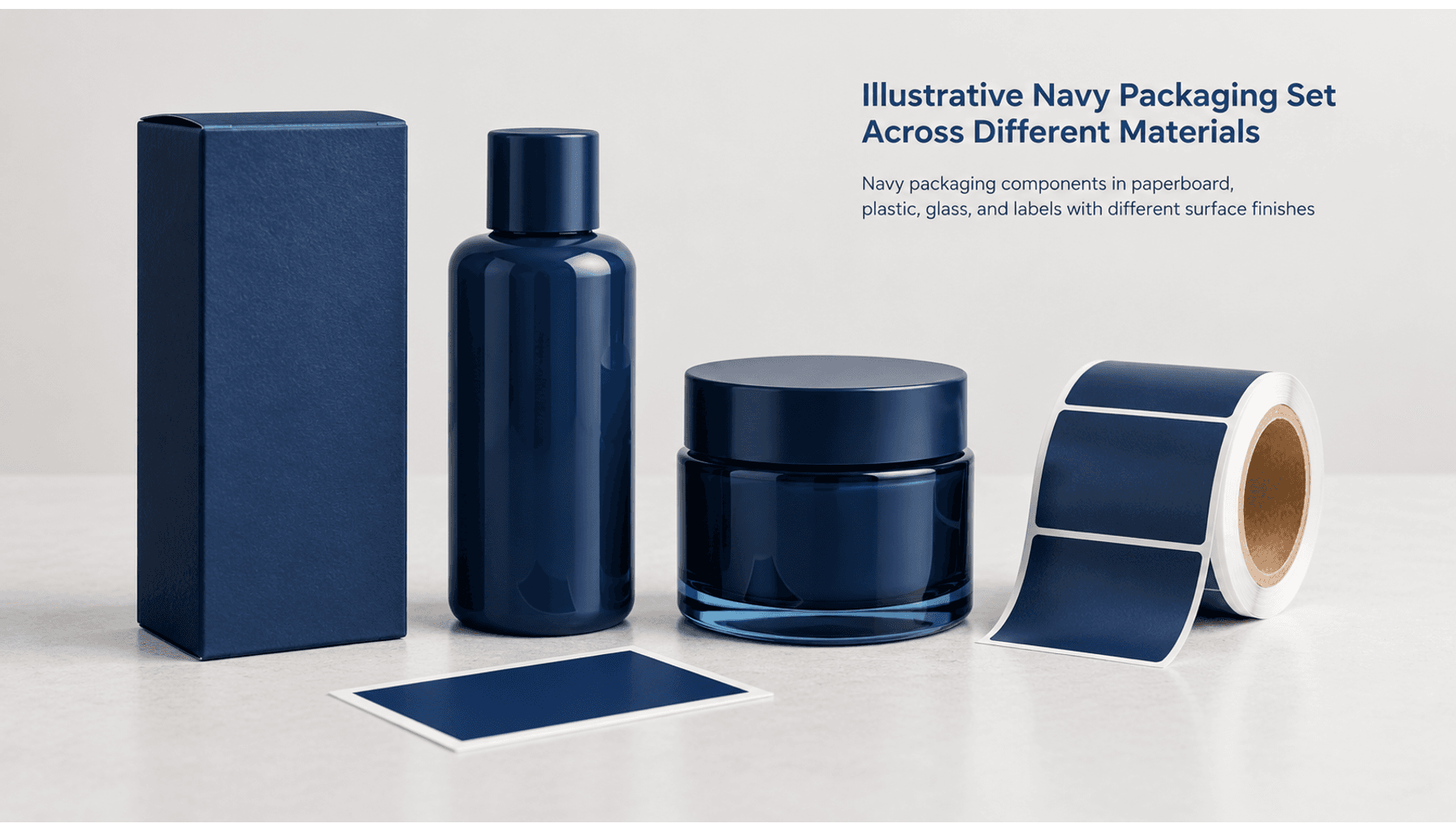
Table of Contents
- Define Packaging Color Matching as an Approval Process
- Why One Color Code Looks Different Across Materials
- Compare Proof Requirements for Paper, Plastic, Glass, and Labels
- Set the Physical Reference and Viewing Conditions
- Use Material-Specific Color Tolerances
- Approve Colors in a Step-by-Step Sampling Sequence
- Coordinate CosunPack Carton, Container, and Label Proofs
- Budget for Proof Rounds and Control Repeat Orders
- Frequently Asked Questions About Packaging Color Matching
- Plan Your Packaging Set With CosunPack
For reliable packaging color matching, start with a physical brand reference and approve finished samples for each material under agreed viewing conditions. Then assess the assembled carton, bottle, glass jar, and label as a coordinated set before production release.
Table of Contents
Define Packaging Color Matching as an Approval Process
Packaging color matching is the approval process used to coordinate a brand color across components with different substrates, colorants, and finishes. A physical color master communicates the design target; signed samples of each finished component become the references for production acceptance.
Consider an illustrative navy personal-care range: a printed carton, an opaque plastic bottle, a coated glass jar, and a printed label. The buyer wants these pieces to look coordinated when displayed together.
Why One Color Code Looks Different Across Materials
The same color reference looks different on a carton and a plastic bottle because the materials scatter, absorb, and reflect light differently. Printing and molding also place color in different layers. A color code identifies the target but leaves these production variables unspecified.
Separate Substrate Color, Ink or Colorant, and Surface Finish
Separate three specifications: substrate, color system, and finish. White coated paperboard supports an ink film; a plastic bottle may contain pigment dispersed through resin; a glass jar may carry an external colored coating.
For the navy set, approve the actual board shade, selected resin, and glass/coating combination before adjusting color. Then assess the final varnish, lamination, texture, or gloss. Changing any layer can change appearance, so a proof made before the final finish has a limited approval scope. Paper optical brighteners can also affect appearance as the ultraviolet content of illumination changes.
Account for Opacity, Translucency, Product Fill, and Background
Confirm whether each component is opaque, translucent, or transparent. A clear label lets the bottle and product fill influence its printed color. White ink beneath the color can reduce that influence, but its opacity needs approval too.
Examine translucent glass at the agreed fill level and against a defined background. Wall thickness and coating opacity can further change the result. Use the actual product for final appearance approval where relevant; a substitute fill supports preliminary review. Navy viewed over white can look different against a dark shelf.
Compare Proof Requirements for Paper, Plastic, Glass, and Labels
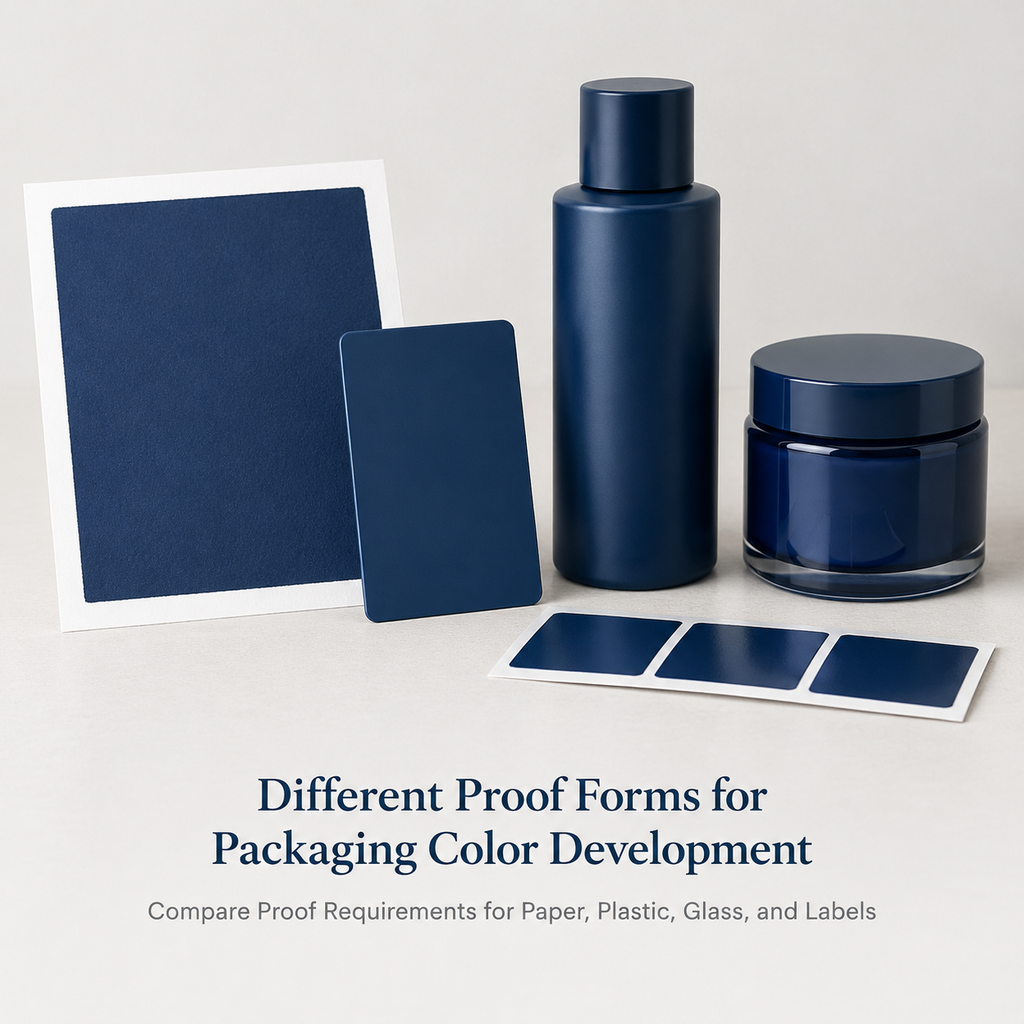
Substrate color proofing needs samples that represent each process. A digital artwork proof helps confirm layout; it cannot establish final color on molded plastic or decorated glass.
| Component | Early development proof | Finished approval sample |
|---|---|---|
| Paperboard carton | Ink drawdown on the intended stock to screen ink and board interaction. | Print made with the intended process, board, and final coating or lamination. |
| Opaque plastic bottle | Color plaque using the proposed resin and pigment formulation. | Molded bottle with representative wall thickness and surface texture; closure reviewed separately. |
| Decorated glass jar | Coating or decoration trial on the selected glass. | Finished jar with agreed coating coverage, opacity, and curing conditions. |
| Printed label | Print trial on the intended label stock, including any white ink layer. | Finished label with selected adhesive, applied to the intended container and evaluated after an agreed application dwell time. |
Record what each proof approves and which production effects remain unrepresented.
Set the Physical Reference and Viewing Conditions
A physical packaging color approval should identify both the brand master and each component’s approved reference by sample identifier, date, revision, and approver. Record substrate or resin grade, colorant or ink reference, finish, artwork version, and filled or empty state.
Keep matched reference sets with the buyer, coordinating supplier, and relevant production facility. Put viewing conditions, measurement procedures, acceptance criteria, and the escalation contact in the same approval record. Photographs help document sample identities and defects; final color decisions need the agreed physical references.
Agree on Light Sources and Viewing Setup
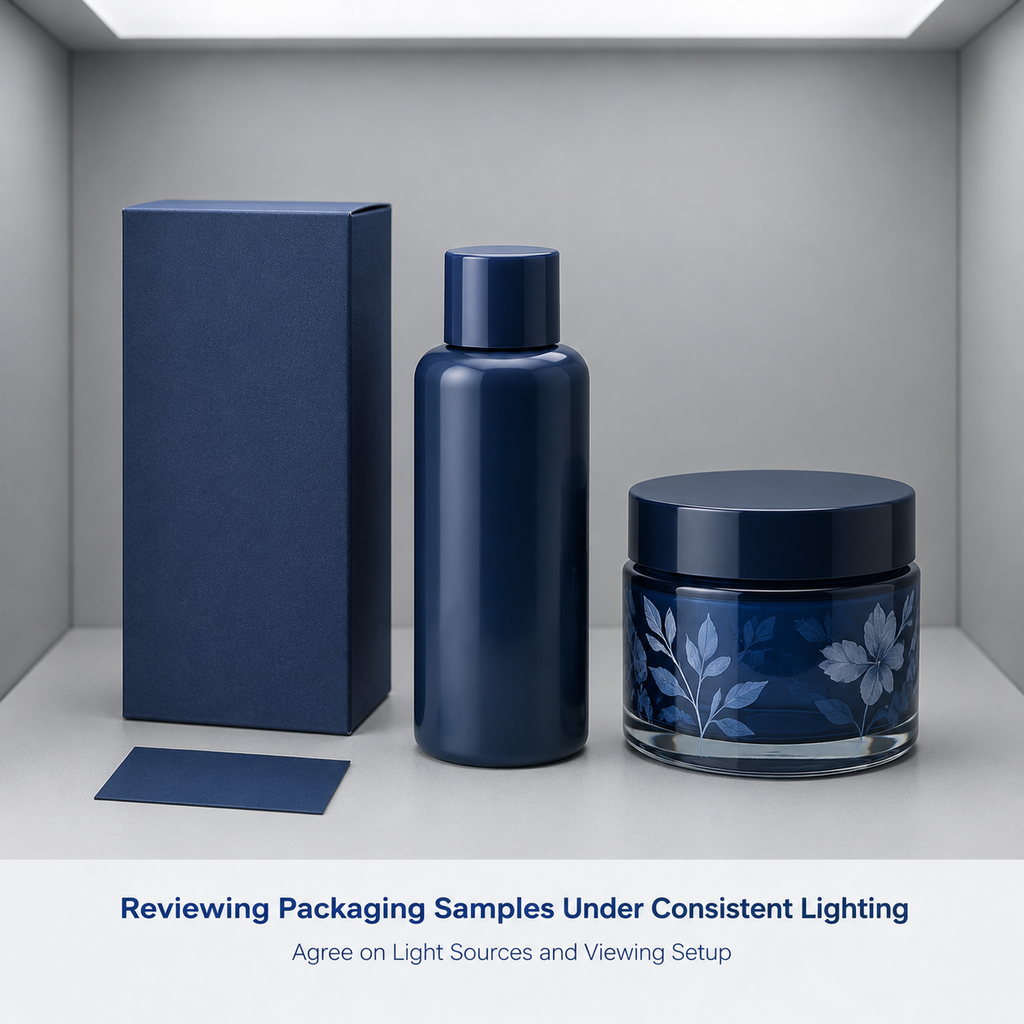
Agree on a primary approval light and an additional source relevant to the US retail or use environment. D50 is a standardized daylight illuminant commonly used for print evaluation; D65 is another daylight reference often used in product color work. Select and record the setup together.
Use maintained, controlled illumination, neutral surroundings, consistent sample orientation, and an agreed observation distance. Avoid mixed window and room light. Samples that match under one source can separate under another, a behavior called metamerism. Two lamps with the same stated color temperature can still have different spectral characteristics.
Check the Assembled Packaging Set Under Relevant Lighting
Judge the printed carton and bottle color side by side, then inspect the jar and applied label in the assembled presentation. Check closures and visible inserts too, because adjacent colors affect perception.
Rotate curved components through the agreed viewing angles. Review the set under the primary approval light and representative retail lighting. Record which adjacent surfaces matter most and who resolves a visual disagreement before production release.
Use Material-Specific Color Tolerances
Paper, plastic, glass, and labels should not automatically share one numerical color tolerance. Each component needs an achievable, validated limit relative to its own approved sample. Cross-material coordination then needs a separate visual decision for the assembled set.
Set the packaging color tolerance after reviewing representative trials and measurement repeatability.
Specify the Measurement Method Before a Delta E Limit
Delta E (ΔE) expresses a calculated color difference, and different formulas produce different results. If using CIEDE2000 (ΔE00), identify that formula explicitly; its values are unitless. Record coordinates in the agreed color space, such as the Commission Internationale de l’Éclairage (CIE) L*a*b* system.
Before setting a limit, specify instrument geometry, aperture, illuminant and standard observer used for calculation, ultraviolet setting where relevant, backing, measurement location, sample orientation, and averaging procedure. State whether surface reflections are included or excluded. Calibrate instruments and check agreement between production sites.
A measurement aperture poorly suited to a curved bottle can give unstable readings. Establish a repeatable fixture or suitable measurement area. Translucent parts may need a defined backing or transmission method. A flat resin plaque helps screen formulations, but final approval still requires the molded part. Numerical acceptance remains one part of the approval decision.
Document Visual Acceptance for Gloss and Translucent Components
Document acceptable gloss, texture, haze, opacity, and coating coverage using finished samples. Where useful, approve boundary samples showing the limiting acceptable appearance for that component.
For translucent glass and clear labels, record the fill state, backing, viewing angle, and areas excluded from measurement. Define how to handle a sample that passes the numerical limit but looks wrong in the agreed setup. Keep packaging color approval alongside separate formulation-compatibility and decoration-adhesion checks where the application requires them.
Approve Colors in a Step-by-Step Sampling Sequence
Use a staged sequence to resolve formulation questions before committing to finished production trials.
- Freeze the brief. Name the brand master, components, artwork revision, materials, finishes, and priority visual relationships.
- Screen color formulations. Review paper ink drawdowns, plastic resin plaques, and glass coating trials, each labeled with its limited approval scope.
- Produce representative components. Use intended production methods and final finishes. Confirm agreed drying, curing, or conditioning before evaluation.
- Build the set. Apply labels to actual containers and review filled appearance where relevant, including closure and carton fit.
- Approve and retain. Sign component standards and the assembled visual reference. Record methods, tolerances, revision, and authority for exceptions.
- Release through the agreed checkpoint. Compare production samples with approved standards under recorded conditions. Resolve deviations in writing before the agreed production or shipment release.
State whether a sample is approved for artwork, structure, color, or all three. A layout approval should never silently become color approval.
Coordinate CosunPack Carton, Container, and Label Proofs
CosunPack’s Guangzhou team coordinates paper printing and converting with plastic and glass supply through specialized equity-partnered facilities across the Pearl River Delta. A coordinated proof schedule can bring the relevant samples together for review.
Use one revision register to connect component drawings, artwork, and color approvals.
| Component option | Coordination task |
|---|---|
| Straight tuck-end carton | Compare finished printed panels with the container; confirm carton dimensions around the selected closure and insert. |
| Plastic cylinder bottle | Approve molded body color and closure appearance separately, then compare with the carton and applied label. |
| Glass cosmetic jar | Trial the selected glass and decoration; confirm the jar, closure, and insert arrangement alongside appearance. |
| Roll labels for containers | Specify label stock, adhesive, any white ink, and finish; approve the label on its intended container. |
Budget for Proof Rounds and Control Repeat Orders
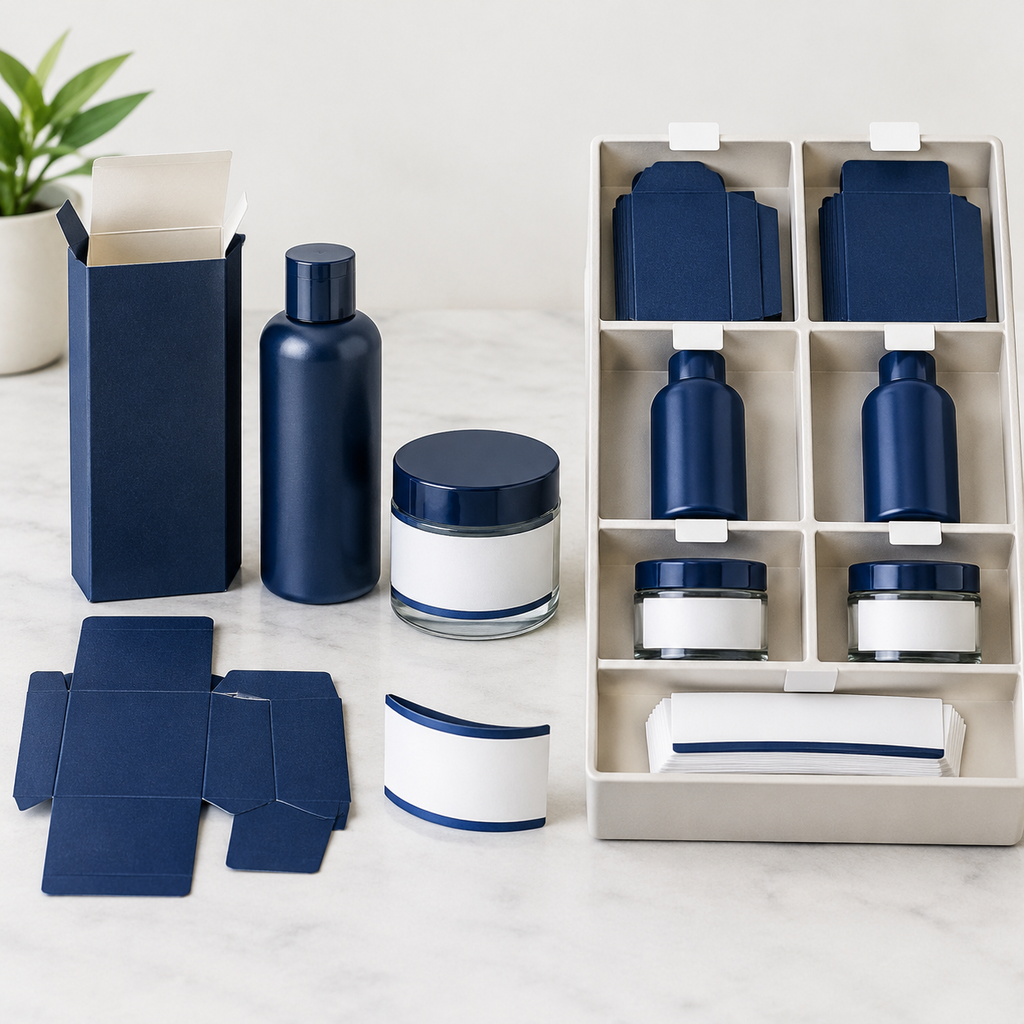
Budget for proof rounds and retained references as development costs. Ask the quotation to identify color formulation, print setup, molding or decoration trials, finishing, sample freight, inspection, and repeat trials. Size, material, tooling, quantity per stock keeping unit (SKU), and destination affect the project quotation.
Approved color samples support repeat orders by providing a stable, dated comparison for each new batch. Compare with the controlled component reference; comparing only with the previous run can allow gradual drift. Store references away from light, heat, and contamination, and agree on review and replacement intervals.
Record board or resin changes, coating and label revisions, process changes, batch identifiers, and signed exceptions. Changes affecting appearance require review and, when necessary, new approval. Use CosunPack’s packaging quality checkpoints to agree on sampling, inspection records, retained production samples, and release responsibilities.
Frequently Asked Questions About Packaging Color Matching
Why does the same color reference look different on a carton and a plastic bottle?
Paperboard, resin, ink, pigment, and finishes interact with light differently. The same code therefore needs separate process trials and finished samples on each material, followed by a visual review of the complete set.
Can paper, plastic, glass, and labels share one color tolerance?
A shared number is meaningful only if the agreed methods and trials support it. Define tolerances against each component’s approved reference and use separate visual criteria for cross-material coordination.
What should a physical packaging color approval include?
Include the brand master, signed finished-component references, sample identifiers and revisions, artwork version, material and finish specifications, viewing conditions, any measurement method and limits, assembled-set acceptance, approver, and release scope.
How can approved color samples support consistent repeat orders?
Keep controlled, dated reference sets and compare every repeat batch with the relevant component standard. Retain batch records, review material or process changes, and replace aged references through a documented reapproval process.
Plan Your Packaging Set With CosunPack
Approve one coordinated visual direction, then establish separate production references for each material. Keep viewing conditions, measurable limits where appropriate, and written change control together with those samples.
FAQ
Why does the same color reference look different on a carton and a plastic bottle?
Paperboard, resin, ink, pigment, and finishes interact with light differently. The same code therefore needs separate process trials and finished samples on each material, followed by a visual review of the complete set.
Can paper, plastic, glass, and labels share one color tolerance?
A shared number is meaningful only if the agreed methods and trials support it. Define tolerances against each component’s approved reference and use separate visual criteria for cross-material coordination.
What should a physical packaging color approval include?
Include the brand master, signed finished-component references, sample identifiers and revisions, artwork version, material and finish specifications, viewing conditions, any measurement method and limits, assembled-set acceptance, approver, and release scope.
How can approved color samples support consistent repeat orders?
Keep controlled, dated reference sets and compare every repeat batch with the relevant component standard. Retain batch records, review material or process changes, and replace aged references through a documented reapproval process.
Plan Your Packaging Set With CosunPack
Share your physical color reference, product and intended use, dimensions or fill capacity, component materials, finish preferences, artwork status, quantity per SKU, destination, and target date. Include the actual product and use conditions for a specification review covering bottle or jar, closure, carton, insert, and label fit. CosunPack can review sampling and production options for a written project quotation.
Use the CosunPack contact page to prepare an email draft. Review and send it from your own account; the form does not send the inquiry or upload files. Attach confidential artwork through the agreed channel after a nondisclosure agreement, if needed.
About CosunPack Engineering
CosunPack is an OEM/ODM packaging manufacturer established in 2008 in Guangzhou, China. We specialize in custom paper boxes, flexible barrier pouches, rigid boxes, and bottles with low MOQ and direct worldwide export.
Need Custom Packaging for Your Brand?
Get free dieline engineering support and a factory-direct quote in 24 hours.