Shopping Bag Load Testing: Specify Handles and Seams

Table of Contents
- Shopping Bag Load Testing: Define the Intended Carrying Task
- Table of Contents
- Write a Load Brief Using the Actual Contents
- Compare Handle Attachments, Seams, and Base Reinforcement
- Comparison Table: Construction Options and Failure Points to Check
- Follow an Agreed Finished-Bag Trial
- Balance Reinforcement, Assembly, Packing Volume, and Project Cost
- Frequently Asked Questions
- Send Your Contents and Carrying Requirements for Sample Planning
Shopping bag load testing should begin with the actual contents and carrying task—not a paper grammage or an unsupported weight rating. A credible trial follows the complete load path from the product and base through the side walls, seams, handle attachments, and handles.
Shopping Bag Load Testing: Define the Intended Carrying Task
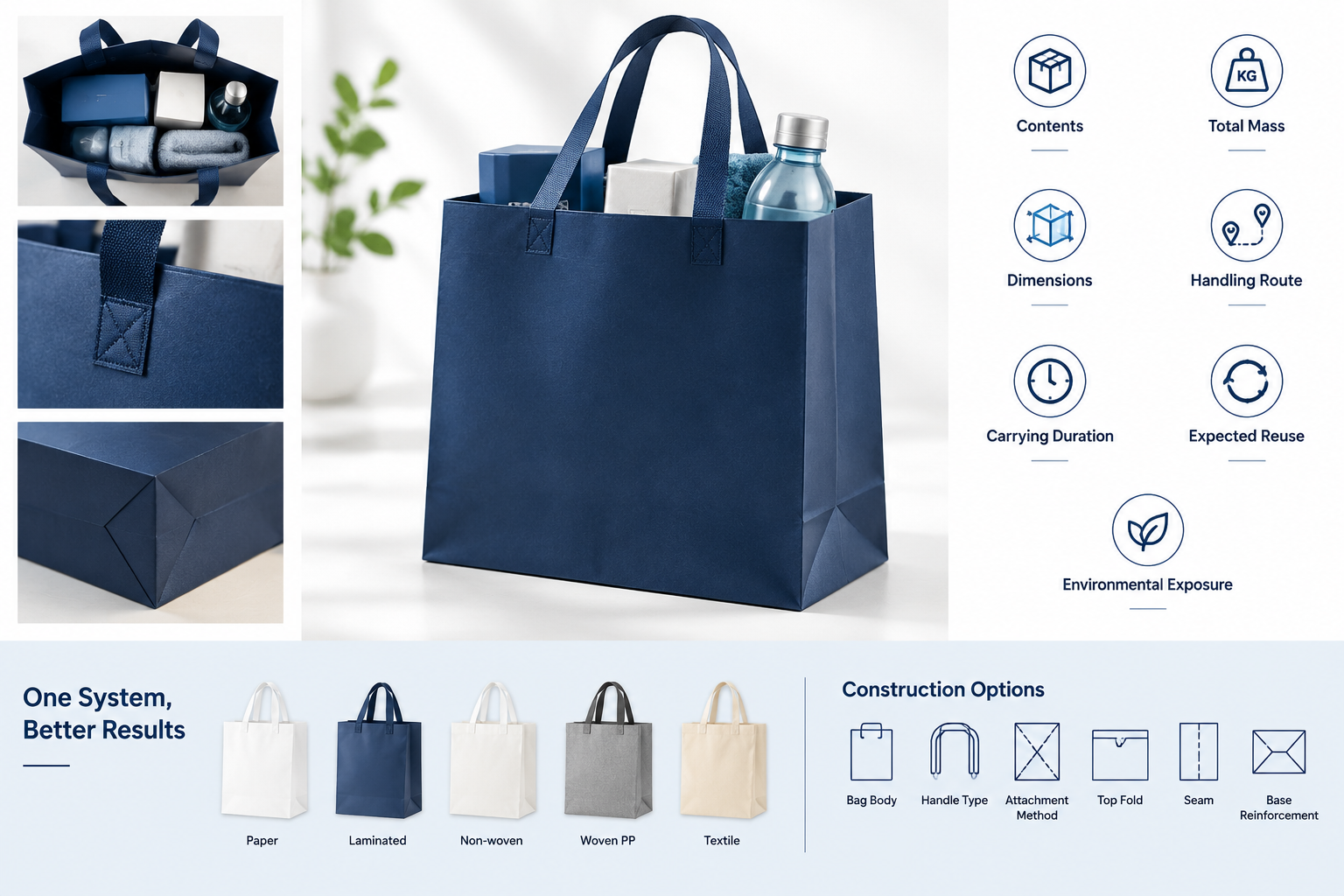
Specify retail bag load requirements as a finished-bag task: contents, total mass, dimensions, handling route, carrying duration, expected reuse, and environmental exposure. The supplier can then select the bag body, handle type, attachment method, top fold, seam, and base reinforcement as one system.
Shopping bag load testing is a controlled trial in which a finished bag is loaded with representative contents and handled under agreed conditions to assess the base, walls, seams, handle anchors, and handles. It is not the same as testing a loose paper handle or measuring paper grammage.
A stronger handle cannot rescue a weak anchor. A reinforced top cannot compensate for a base that opens under a concentrated bottle load. The useful question is not “How many pounds can this bag carry?” but “Can this specified construction carry this defined load through the intended retail experience?”
CosunPack’s shopping bag construction options cover paper, laminated formats, non-woven and woven polypropylene, and textile bags. Catalog structures are starting points; the declared load and trial conditions still need to be written into the project specification.
Table of Contents
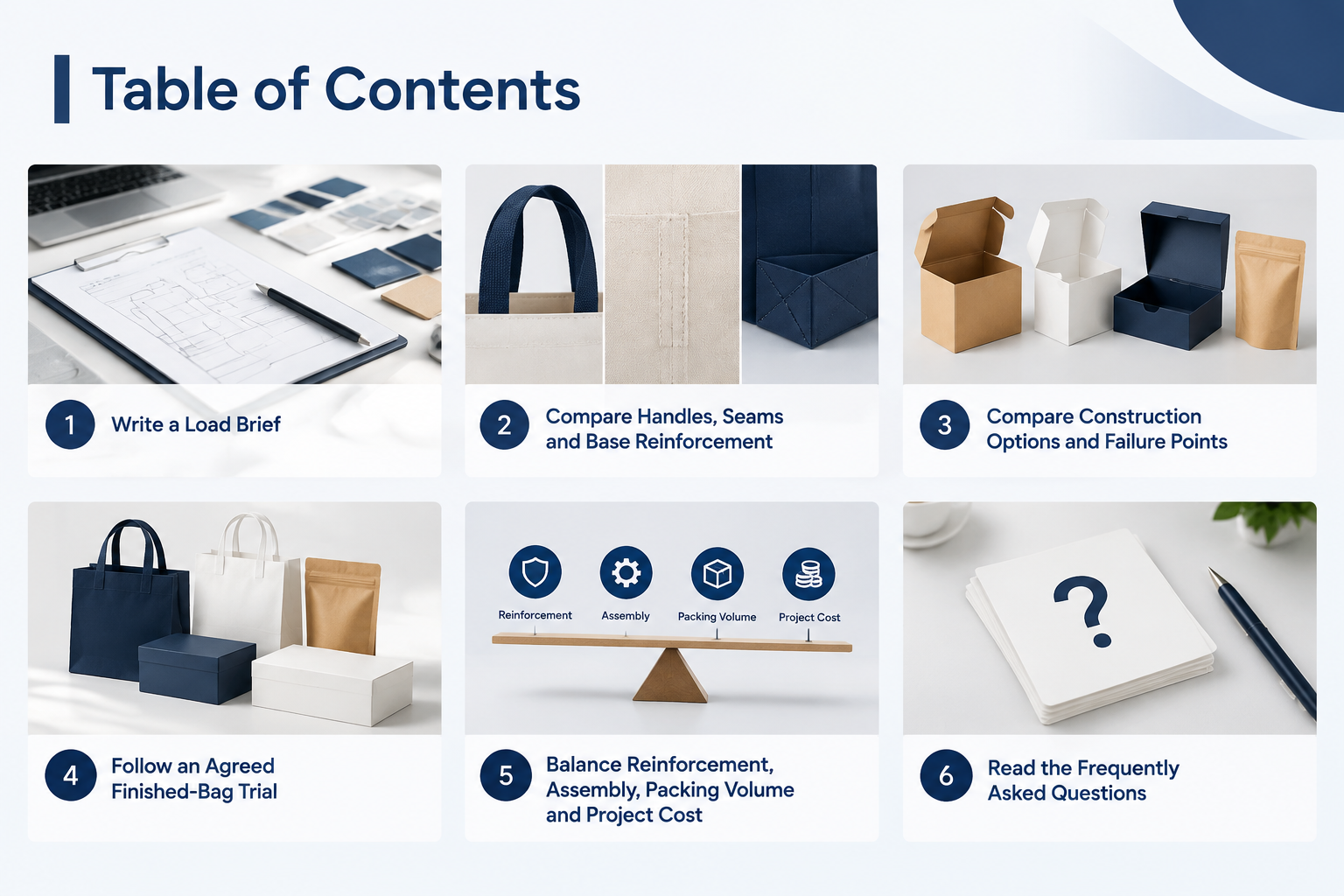
- Write a load brief using the actual contents
- Compare handles, seams, and base reinforcement
- Compare construction options and failure points
- Follow an agreed finished-bag trial
- Balance reinforcement, assembly, packing volume, and project cost
- Frequently asked questions
Write a Load Brief Using the Actual Contents
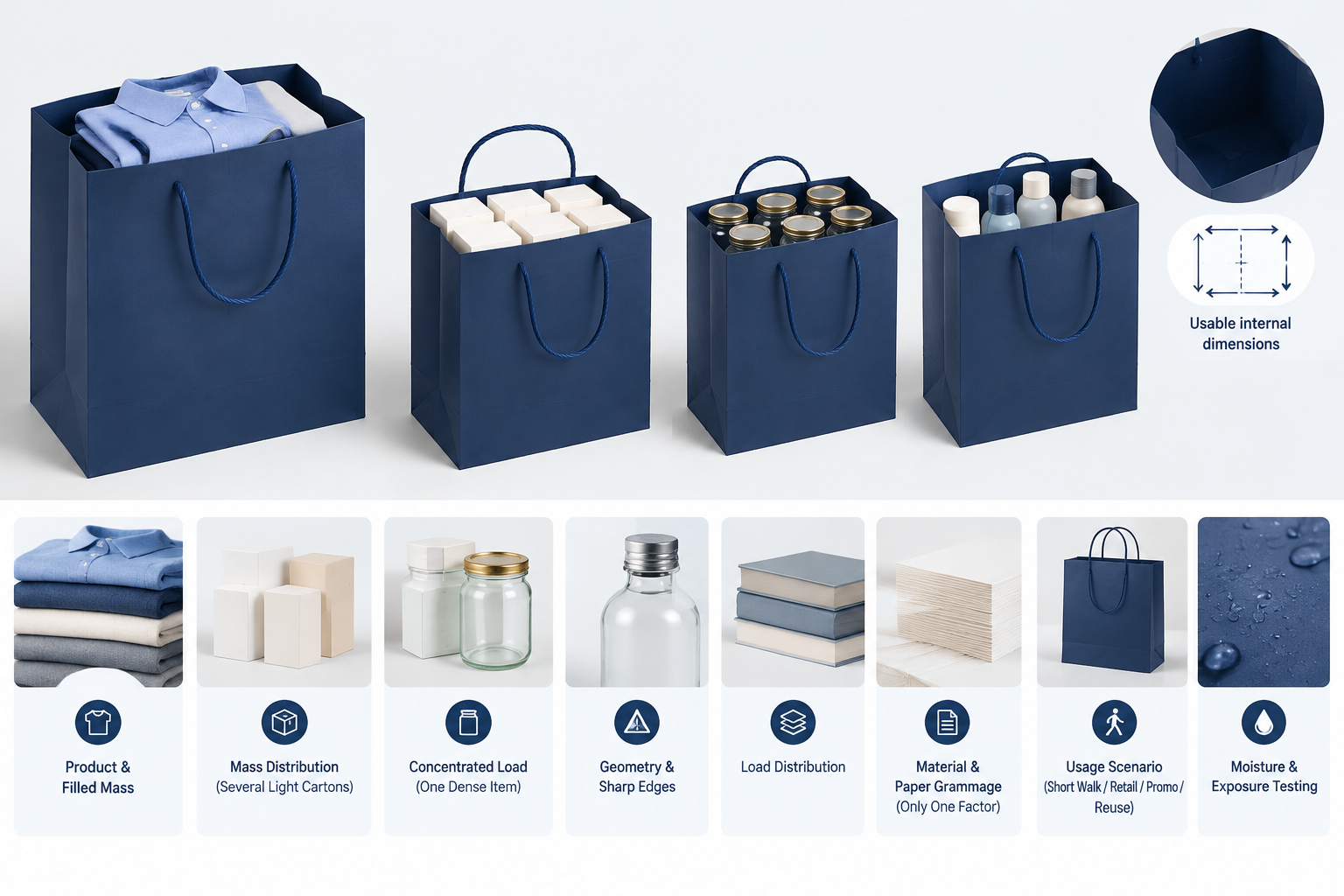
Start the brief with the product, not the bag material. Record the filled mass for the heaviest intended combination and identify whether that mass is spread across several light cartons or concentrated in one dense item. A bag carrying folded apparel has a different load path from one carrying glass jars, books, bottles, or boxed cosmetics.
Record Mass, Shape, Edges, and Load Distribution
Give the supplier a practical load description:
- Mass: state the target filled mass in kilograms and pounds, plus the heaviest expected combination.
- Geometry: provide each item’s length, width, height, and orientation inside the bag.
- Contact: identify sharp corners, hard rims, bottle shoulders, abrasive packaging, and loose contents that can shift.
- Distribution: explain whether the contents sit flat, lean against one wall, or create a point load at the base.
- Clearance: specify the opening and usable internal dimensions, not only the outside bag size.
Paper grammage—the mass of paper per unit area—does not establish finished bag carrying capacity. It affects stiffness and tear behavior, but the result also depends on fiber structure, grain direction, moisture, creasing, glue, folded top construction, handle attachment, base folds, and workmanship. Treat grammage as one input to a construction specification, never as a weight rating.
Describe Carrying Duration, Repeated Use, and Moisture Exposure
State how the bag will be used: a short walk from a store counter, a full day of retail handling, promotional distribution, or repeated consumer reuse. Include lifting from a counter, setting down, swinging, one-handed carrying, transfer between people, and loading into a vehicle. These actions create different stress than a static hanging load.
For moisture, describe the actual exposure rather than writing “water-resistant.” A paper bag may encounter condensation, wet pavement, chilled products, rain, or a damp hand. Test the finished construction after the agreed exposure, because wet paper, adhesive, printed coatings, and textile seams can behave differently. Do not infer food-contact suitability, recyclability, or weather performance from a material name alone.
Compare Handle Attachments, Seams, and Base Reinforcement
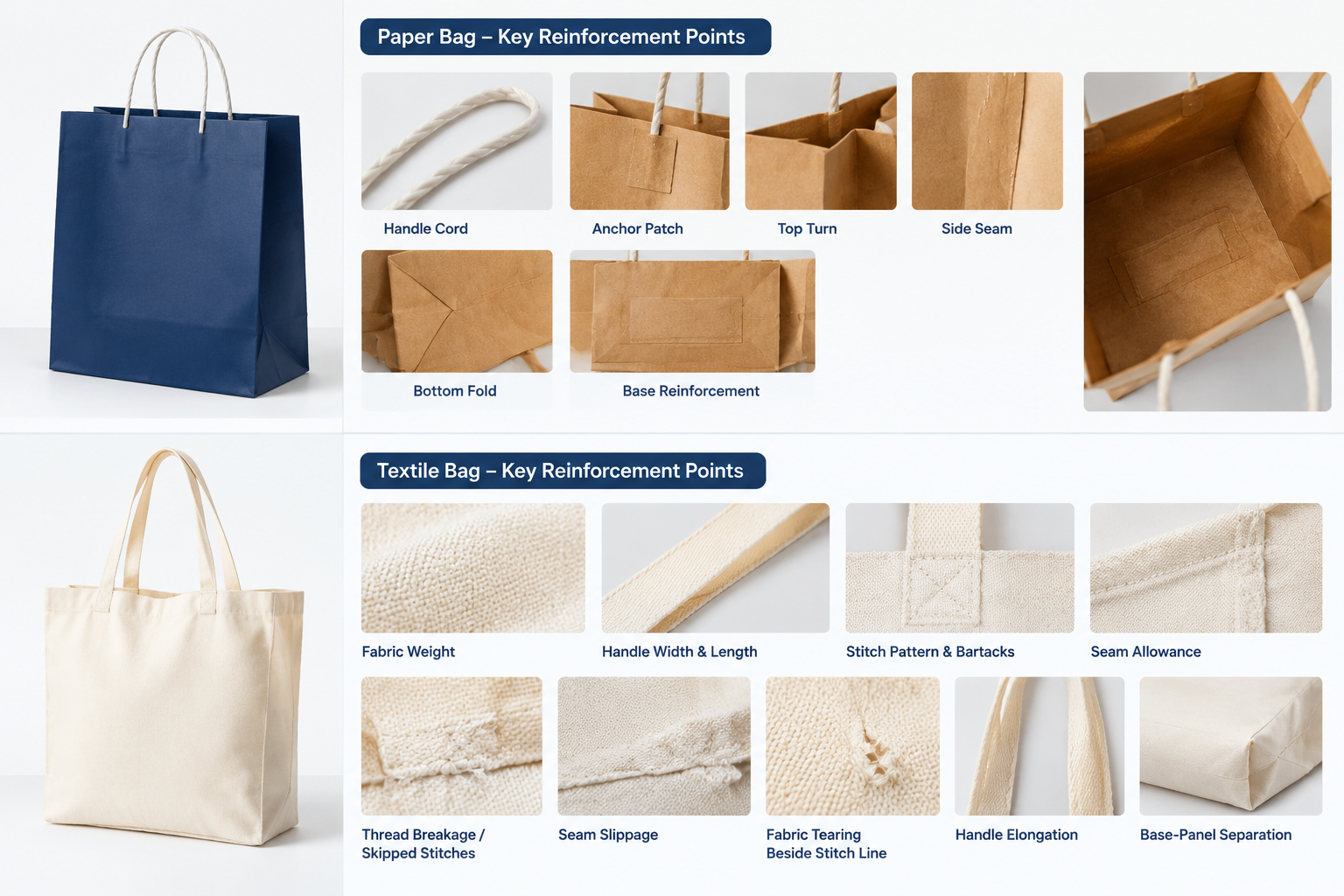
Choose reinforcement around the weakest point in the load path. A wide handle may feel comfortable while its attachment tears through the top panel; a thick textile may survive the pull while the side seam opens; a strong top may still fail when the base folds concentrate force at one corner.
Paper Bag Glue Areas, Folded Tops, and Reinforced Bases
For paper bags, inspect the handle-to-wall attachment, interior patches or reinforcement pieces, top turn, side seam, bottom fold, and base board or insert. Glue coverage and bonding position matter as much as the paper itself. A twisted paper handle bag, such as the twisted-handle paper format, should be assessed with its actual handle cord, anchor patch, top fold, and bag dimensions—not with a handle sample tested in isolation.
Check for tearing radiating from punched holes, adhesive lift, delamination, crushed creases, bottom opening, and side-wall distortion. Laminated paper can improve surface durability, but the laminate does not automatically strengthen every fold or glue joint. If the contents are dense or have hard corners, a base reinforcement may be more useful than simply increasing paper weight.
Textile Bag Stitching, Handle Anchors, and Seams
For cotton canvas, non-woven polypropylene, woven polypropylene, rPET, or jute bags, record fabric weight, handle width and length, stitch pattern, stitch density if specified, bartacks, seam allowance, and anchor patch dimensions. A cotton canvas tote may distribute force through sewn webbing and reinforced anchor points, but performance still depends on the finished pattern and stitch execution.
Inspect thread breakage, skipped stitches, seam slippage, fabric tearing beside the stitch line, handle elongation, and base-panel separation. Pulling a handle straight upward is useful, but a carrying trial must also include angled pulls and movement. The bag is a soft structure; it will not load symmetrically every time.
Comparison Table: Construction Options and Failure Points to Check
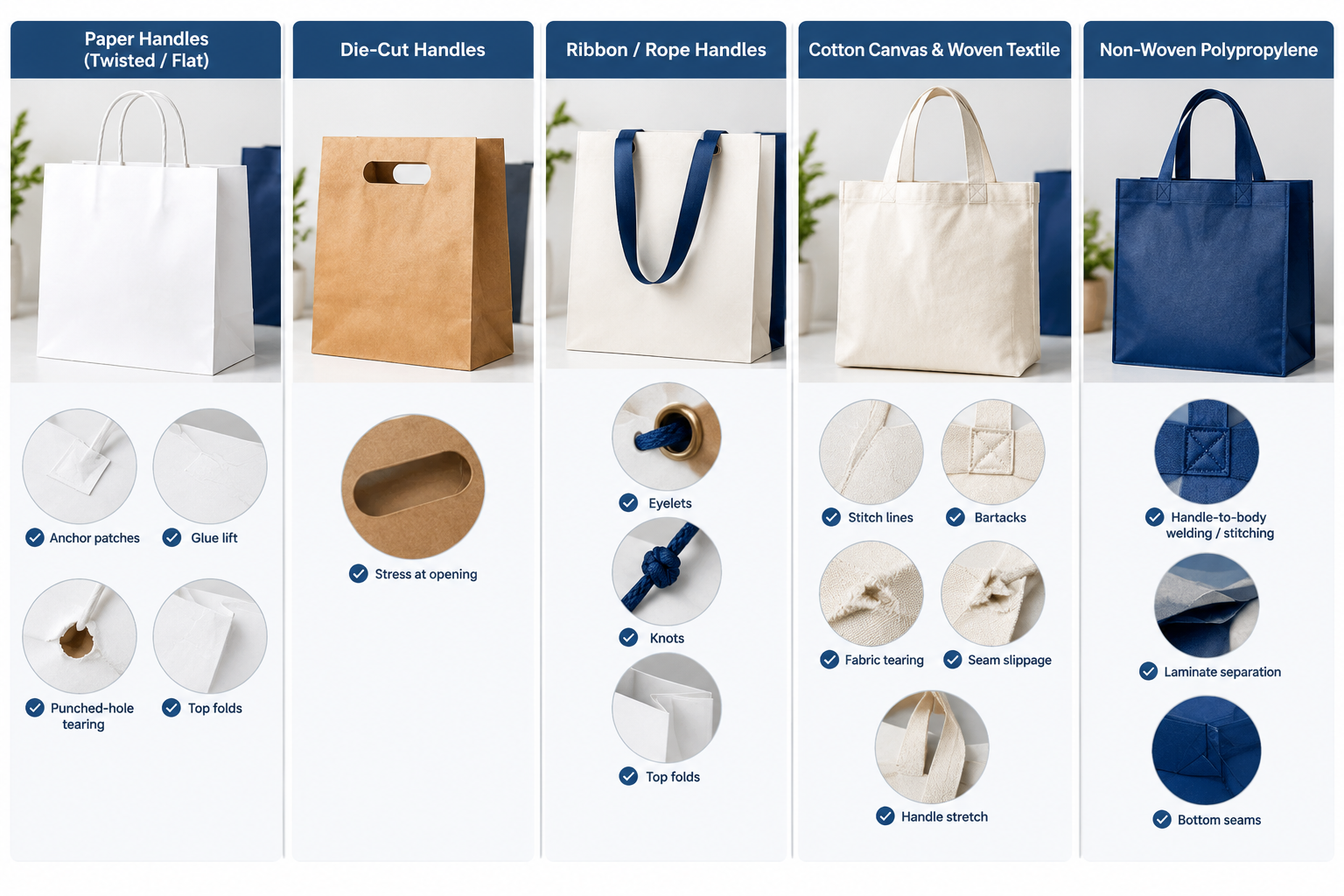
The table below is a selection framework, not a universal capacity chart. The finished bag, actual contents, and agreed trial determine acceptance.
| Construction | Useful when | Inspect first | Typical specification questions |
|---|---|---|---|
| Twisted or flat paper handles | Retail and gift presentation with moderate carrying time | Anchor patch, glue lift, punched-hole tear, top-fold opening | Handle attachment method? Top turn? Base reinforcement? Moisture exposure? |
| Die-cut paper handle | Simple economical bags with integrated handle openings | Stress concentration at the cutout, top-panel tearing, edge splitting | Cutout geometry? Reinforcement patch? Intended load distribution? |
| Ribbon or rope paper bag | Premium gifting where handle feel matters | Eyelet or knot area, top fold, side seam, base distortion | How is the handle anchored? Does the closure create a point load? |
| Cotton canvas or woven textile | Longer carrying time or planned reuse | Stitch line, bartack, fabric tear, seam slippage, handle stretch | Fabric weight? Webbing width? Stitch pattern? Wash or moisture exposure? |
| Non-woven polypropylene | Promotional and reusable programs needing a light textile-like body | Handle-to-body weld or stitch, laminate separation, bottom seam | Fabric construction? Lamination? Handle attachment? Repeat-use expectation? |
Follow an Agreed Finished-Bag Trial
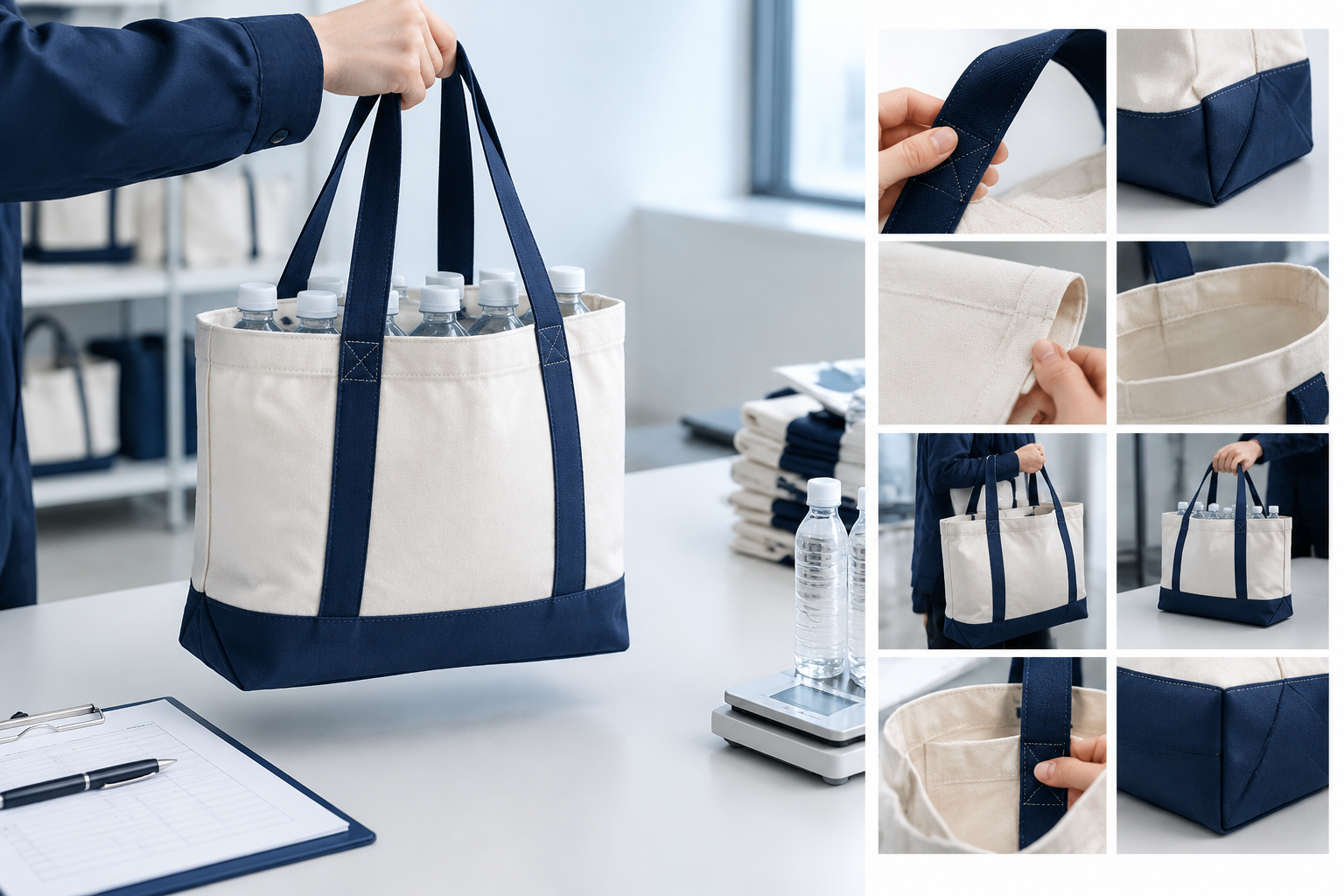
Run the trial on finished samples made with the proposed materials, attachments, print, coatings, and assembly method. A hand-built prototype can reveal geometry problems, but it may not represent production glue coverage, stitching, folding, or material variation. Keep the approved sample and its revision identifier with the written specification.
Set Conditioning, Loading, Handling, and Acceptance Criteria
- Condition: record the storage environment and any agreed dry, damp, cold, or warm exposure before loading.
- Load: use representative contents or accurately weighted substitutes placed in the intended arrangement.
- Handle: define lifts, carries, transfers, set-downs, turning, and any repeated cycles. Record distance or duration where relevant.
- Observe: inspect handles, anchors, seams, walls, creases, and base after each stage—not only after final failure.
- Accept: write pass/fail criteria before testing. Decide whether cosmetic deformation, handle stretch, adhesive lift, or minor creasing is acceptable.
Do not report a result without the conditions. “Passed load test” is incomplete unless the record states the load, contents, sample construction, conditioning, handling sequence, inspection method, and acceptance rule.
Document Failure Location and Sample-to-Sample Variation
Photograph the first visible change and label its location: handle cord, anchor patch, top fold, side seam, bottom fold, base insert, stitch line, or fabric beside the seam. Record whether the issue appeared in one sample or across the group. A single failure may indicate a workmanship defect; repeated failure at the same location points to a design or material decision.
CosunPack describes agreed specifications, incoming, in-process, and outgoing quality checks, testing scope, and batch records on its packaging quality checkpoints page. Confirm the exact inspection plan, sample quantity, records, and any independent testing responsibility in the quotation rather than assuming a catalog statement is a finished-bag certification.
Balance Reinforcement, Assembly, Packing Volume, and Project Cost
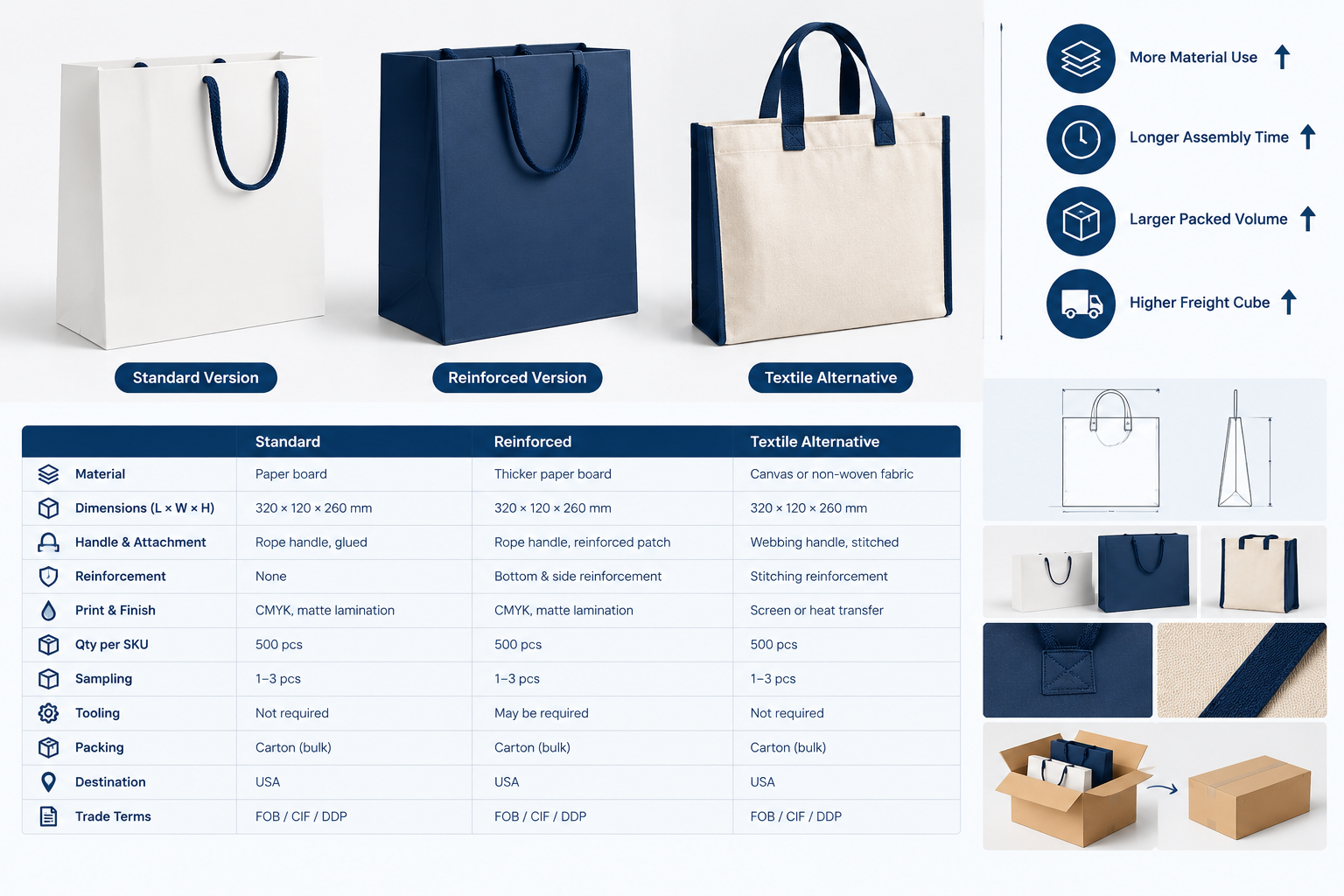
Reinforcement is not free performance. Additional patches, thicker board, larger anchor areas, heavier webbing, more stitching, or a base insert can increase material use, assembly time, packed volume, and freight cube. The cheapest unit price may become the expensive option if the bag requires hand rework or fails during retail handling.
Ask for options rather than one unexplained construction: a standard version, a reinforced version, and—where appropriate—a textile alternative. Compare the complete quotation by material, dimensions, handle and attachment method, reinforcement, print and finish, quantity per stock-keeping unit, sampling, tooling, packing, destination, and named trade terms.
Packaging development is easier to control when the drawing, physical sample, artwork revision, trial record, and quotation refer to the same specification. CosunPack’s coordinated engineering and sampling process can support this review, but the load target and acceptance criteria must come from the buyer’s actual use case.
Frequently Asked Questions
How should a buyer specify shopping bag load requirements?
State the filled mass, contents, dimensions, load distribution, carrying duration, handling actions, reuse expectation, moisture exposure, and pass/fail criteria. Include the exact handle, seam, base, and reinforcement construction under review.
Does paper grammage establish a finished bag’s carrying capacity?
No. Grammage describes paper mass per area, not the performance of the finished bag. Handles, glue, folds, grain direction, seams, base construction, moisture, geometry, and production consistency also affect carrying behavior.
Which failure points should a trial inspect?
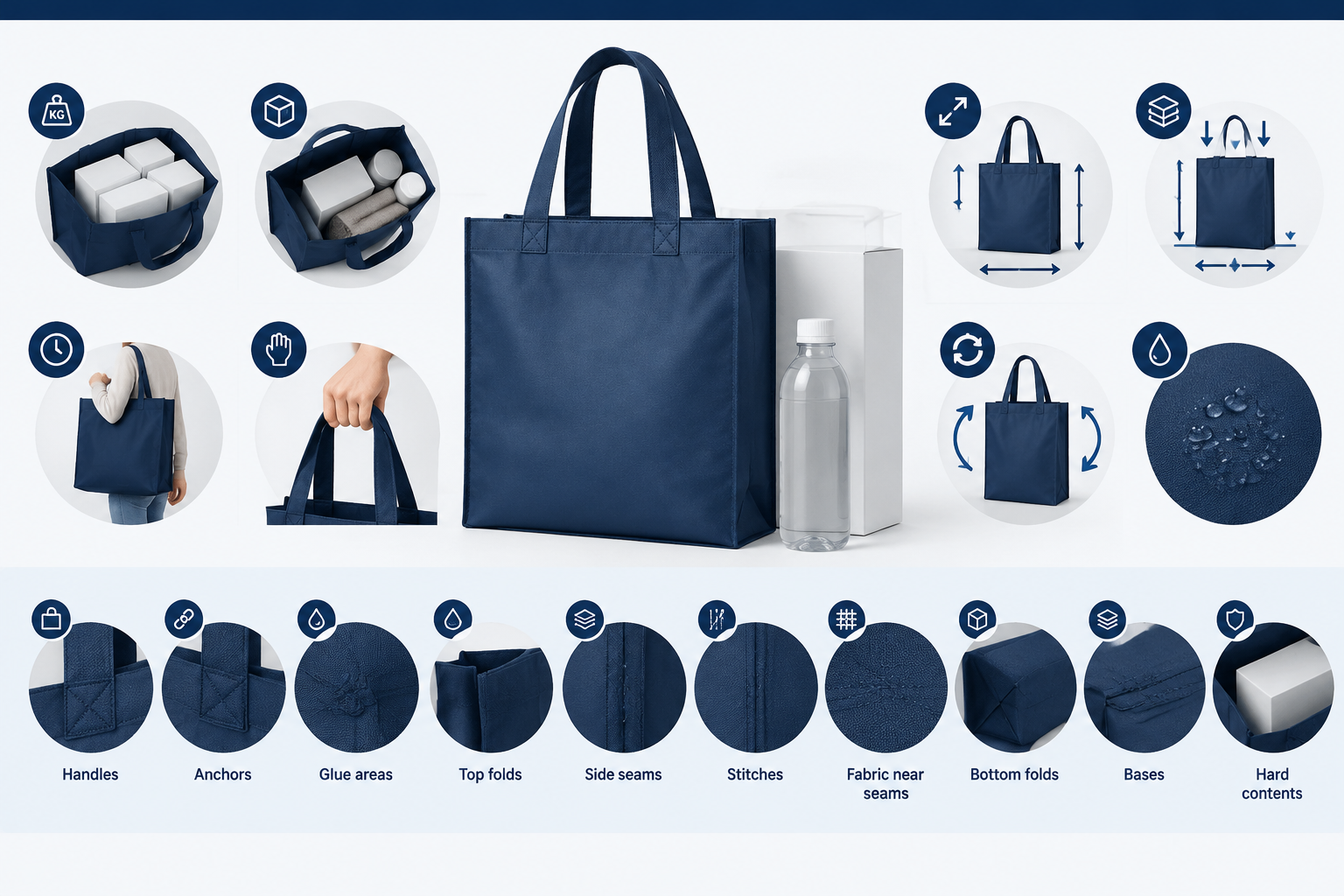
Inspect handle elongation or breakage, anchor-patch tearing, glue lift, punched-hole splitting, top-fold opening, side-seam separation, stitch failure, fabric tearing beside stitches, bottom-fold opening, base distortion, and damage caused by hard or sharp contents.
How should repeated carrying and moisture exposure be included?
Replicate the intended use with defined lifts, carries, transfers, set-downs, and cycles. For moisture, identify the real exposure—condensation, rain, wet products, or damp hands—and condition or expose finished samples accordingly. Record the sequence and acceptance rule.
Send Your Contents and Carrying Requirements for Sample Planning

For a useful sample review, send the product dimensions or fill capacity, filled mass, quantity per stock-keeping unit, preferred bag material and finish, handle preference, artwork status, intended use, destination, and target date. Add photographs or drawings showing hard edges, bottles, boxes, or unusual load distribution.
CosunPack can review the structure, handle and base construction, sampling route, and production options for a written project quotation. Use the bag construction sample inquiry page to prepare your message, then review and send the email to [email protected] from your own account. Website forms prepare email drafts; they do not automatically submit an inquiry or upload files. Share confidential artwork through the agreed channel after an NDA if needed. Sample availability, courier charges, tooling, and lead times are confirmed for the specific project.
A sound approval decision is simple: define the real carrying task, test the complete bag, record where stress appears, and approve only the construction tied to those conditions.
FAQ
How should a buyer specify shopping bag load requirements?
Specify filled mass, contents, dimensions, load distribution, carrying duration, handling actions, reuse expectation, moisture exposure, and pass/fail criteria. Include the proposed handle, attachment, seam, base, and reinforcement construction.
Does paper grammage establish a finished bag’s carrying capacity?
No. Grammage is one material input. Finished performance also depends on folds, glue, grain direction, handle attachments, seams, base construction, moisture, geometry, and production consistency.
Which handle, seam, and base failure points should be inspected?
Inspect anchor-patch tearing, glue lift, punched-hole splitting, top-fold opening, side-seam separation, stitch failure, fabric tearing beside stitches, bottom-fold opening, base distortion, handle stretch, and damage from hard contents.
How should repeated carrying and moisture exposure be included?
Define the lifts, carries, transfers, set-downs, and cycles that represent actual use. Describe moisture exposure precisely—such as condensation, rain, wet products, or damp hands—and test finished samples under those conditions.
Plan Your Packaging Set With CosunPack
Share your product, dimensions or fill capacity, quantity per stock-keeping unit, preferred materials and finishes, artwork status, destination, and target date. CosunPack can review the bag structure, handle and base construction, sampling, and production options for a written project quotation.
Use the contact page to prepare your inquiry, then review and send the email to [email protected]. Sample availability, courier charges, tooling, and lead times are confirmed for your project.
About CosunPack Engineering
CosunPack is an OEM/ODM packaging manufacturer established in 2008 in Guangzhou, China. We specialize in custom paper boxes, flexible barrier pouches, rigid boxes, and bottles with low MOQ and direct worldwide export.
Need Custom Packaging for Your Brand?
Get free dieline engineering support and a factory-direct quote in 24 hours.